
RPE Research · Construction Operations
Outsourcing Construction Management: Costs, Benefits, Risks & Best Practices
Understanding the financial and operational advantages of separating construction project management from back-office project administration.
Introduction: The Hidden Administrative Burden of Construction Management
Construction projects are not managed from a spreadsheet, and they are not built from an office. They are built in the field, where decisions must be made, subcontractors must be coordinated, materials must arrive, schedules must be maintained, and problems must be resolved before they interfere with production.
Yet a significant portion of modern construction management takes place away from the actual work. Project managers, superintendents, and project engineers spend considerable time preparing submittals, tracking requests for information, organizing change order documentation, updating schedules, processing payment information, maintaining project records, and responding to administrative requirements.
None of these responsibilities is unnecessary. Every one of them serves a legitimate purpose. Submittals establish what materials and equipment are proposed for incorporation into the work. RFIs document questions requiring clarification. Change order records preserve the history and financial consequences of modifications. Schedules establish the sequence and timing of construction activities. Payment applications document completed work and support project cash flow.
The problem is not that construction projects require extensive administration. The problem arises when contractors expect the same individuals responsible for project execution to personally manage every administrative process supporting that execution.
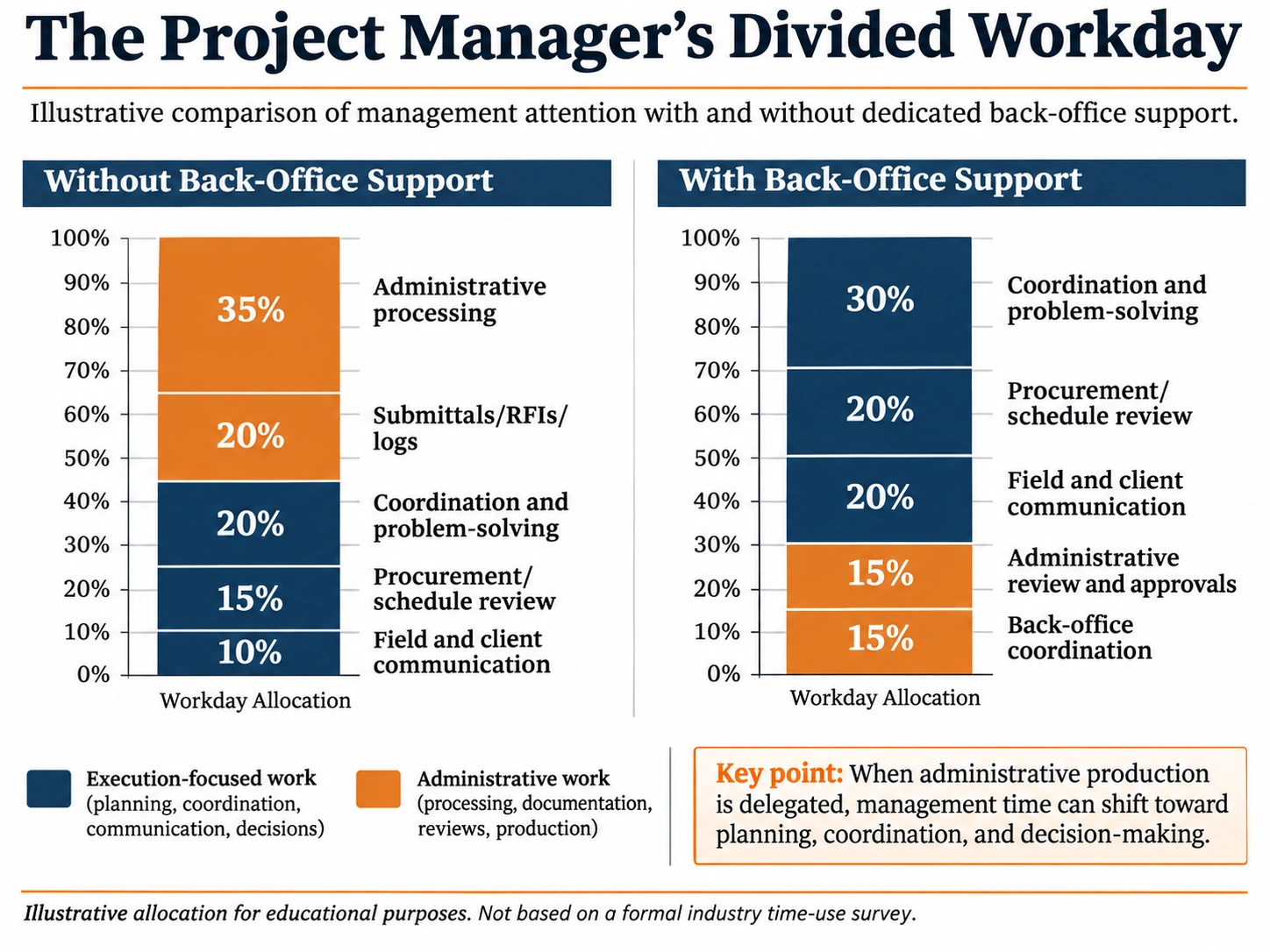
A project manager who spends several hours preparing document packages has several fewer hours available for cost control, procurement decisions, subcontractor coordination, and project planning. A superintendent who must repeatedly interrupt field operations to respond to administrative requests has less uninterrupted time to supervise production and coordinate upcoming work.
The construction industry has traditionally addressed these demands by adding personnel, assigning more responsibilities to existing employees, or accepting that project managers and engineers will work additional hours to keep up.
There is another approach.
Open full-size exhibit
Contractors can retain direct responsibility for construction operations, contractual decisions, and field management while assigning selected administrative functions to a dedicated back-office support operation. This approach, commonly described as outsourcing construction management support, allows contractors to purchase defined administrative capabilities without automatically expanding their permanent management staff.
The objective is not to replace the people who manage construction. It is to provide those people with an organized administrative support system that allows them to concentrate on managing the project.
Understanding when this model works, what it costs, and where its limitations exist requires examining how construction responsibilities are actually divided.
1. What Is Outsourcing Construction Management?
Outsourcing construction management can describe several different business arrangements. At one end of the spectrum, an owner may retain an outside construction management firm to oversee major portions of a project. At the other end, a general contractor may hire a specialized provider to handle a limited administrative function, such as submittal tracking or schedule updating.
These arrangements should not be confused.
For a contractor already responsible for performing construction, outsourcing selected back-office functions does not mean transferring overall project management responsibilities to another organization. The contractor remains responsible for fulfilling its contract, supervising its subcontractors, controlling project costs, maintaining required quality and safety procedures, and delivering the completed work.
What changes is the allocation of administrative production.
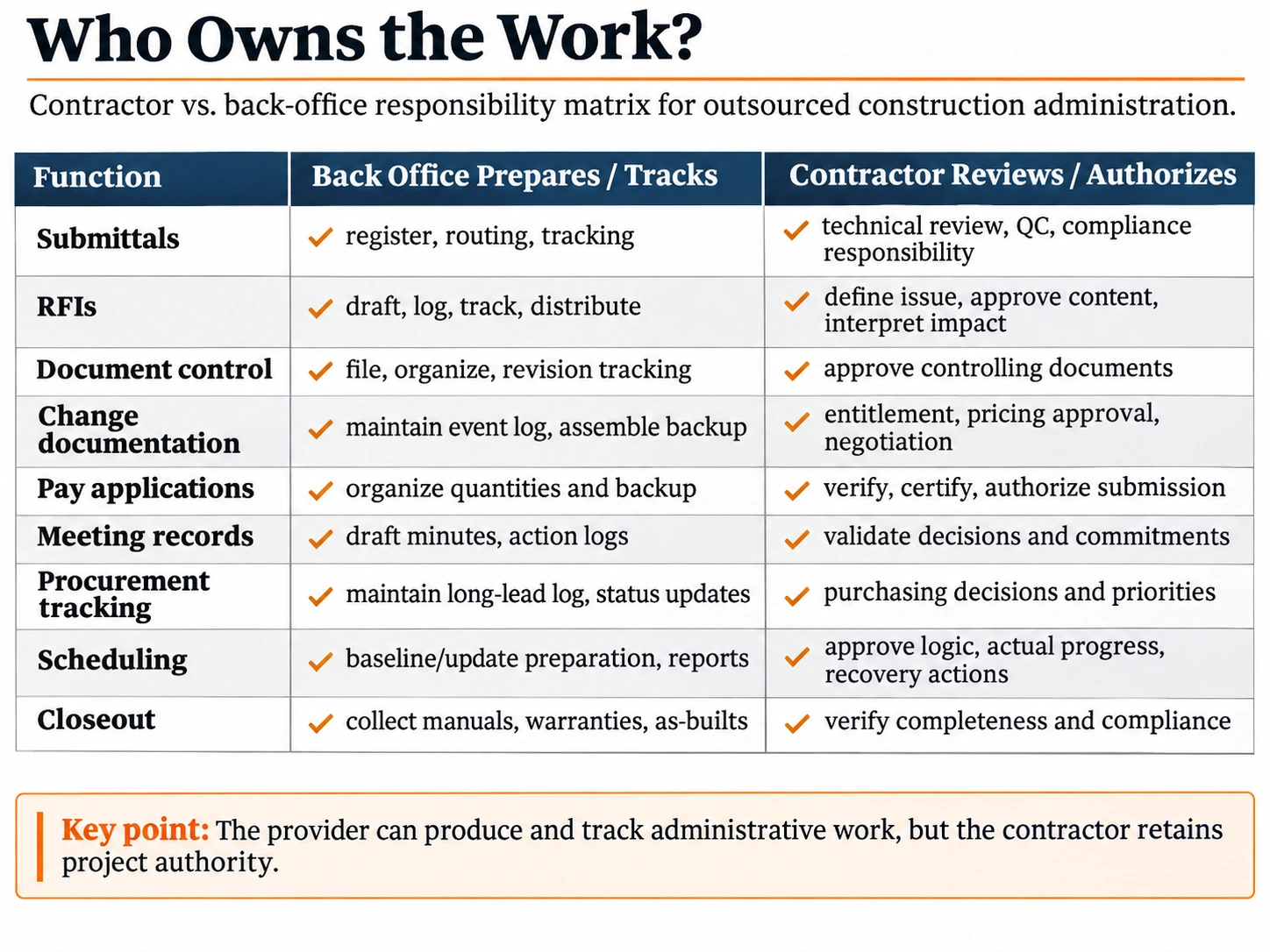
An internal project manager may continue to establish priorities, approve correspondence, evaluate cost changes, coordinate with the owner, and direct the project team. An outsourced administrative provider may support that manager by maintaining logs, assembling documentation, preparing draft correspondence, tracking unresolved issues, and providing timely reporting.
The distinction is between performing administrative work and exercising management authority.
Consider a request for information concerning a discrepancy between architectural and structural drawings. The project manager and appropriate technical personnel must understand the discrepancy, determine its potential effect on the work, and approve the question being submitted. An administrative provider can format the RFI, identify the supporting drawing references, organize attachments, enter the document into the project system, and track the response.
When the answer is returned, the contractor evaluates the technical and contractual implications. The administrative provider can then update the register, distribute the authorized response, and maintain the record.
The critical decisions remain with the contractor. The repetitive document processing does not necessarily have to.
Open full-size exhibit
This division of responsibilities is particularly applicable to contractors working on multiple projects, smaller organizations without extensive administrative departments, and businesses experiencing uneven project workloads.
It can also benefit larger contractors that need supplemental administrative capacity during periods of increased activity without permanently increasing their staffing commitments.
The defining principle is simple: construction management authority remains with the contractor, while clearly identified administrative responsibilities may be performed by a qualified outside provider.
2. Why Construction Contractors Are Reconsidering Their Staffing Models
The construction industry operates in a labor market where qualified personnel can be difficult to recruit, expensive to retain, and challenging to deploy efficiently across changing project workloads.
According to the Associated General Contractors of America's September 2026 workforce survey, 82% of responding construction firms reported openings for salaried positions. Among firms with those openings, 87% reported that filling them was as difficult or more difficult than the preceding year.
The same survey found substantial differences in business conditions. Some contractors were increasing employment, while others had reduced staffing. This combination illustrates an important feature of construction labor demand: the need for personnel varies by market, project type, geographic region, and individual contractor workload.
Associated Builders and Contractors separately estimated that the U.S. construction industry would need approximately 349,000 net new workers in 2026 to meet demand. Although that figure covers the broader construction workforce rather than project administration specifically, it reinforces the importance of allocating available personnel effectively.
These statistics do not demonstrate that outsourcing is automatically the solution to construction labor shortages. They do, however, help explain why contractors are examining alternatives to hiring additional permanent employees for every increase in workload.
The Cost of Administrative Capacity
Hiring a construction project engineer, coordinator, or administrator creates more than a salary obligation.
An employer must consider payroll-related costs, benefits, paid leave, onboarding, software access, equipment, management supervision, and the time required for the employee to become familiar with company procedures and project requirements.
The Bureau of Labor Statistics reported a median annual wage of $114,990 for construction managers in May 2025. During the same period, the national median for project management specialists was $102,320. These are occupational benchmarks, not a universal salary scale for construction project engineers, whose duties and compensation vary substantially.
BLS employer compensation data for June 2026 showed that wages and salaries represented approximately 70% of total private-industry employer compensation, while benefits represented the remaining 30%.
These figures demonstrate why the actual employer cost of maintaining a position is generally greater than the base wage alone.
The challenge becomes particularly apparent when the contractor needs only part of an employee's available capacity.
A company managing two active projects might need substantial assistance with submittals during the opening months of construction. Once major equipment and material approvals are completed, the same projects may require much less submittal processing. Hiring a full-time employee specifically for that temporary workload creates an ongoing staffing obligation after the initial demand declines.
Conversely, assigning the additional work to an existing project manager may avoid a new hire but overload the management staff.
Outsourcing offers a third option: purchasing a defined service for a defined period, subject to the scope, capacity, and commercial terms of the agreement.
The Operational Cost of Divided Attention
There is another cost that does not appear directly on the payroll register.
When project managers and superintendents become overloaded with administrative responsibilities, their available management capacity is reduced.
A project manager must understand contract requirements, coordinate project resources, monitor costs, evaluate changes, manage procurement, and anticipate problems that could affect the schedule. These responsibilities require attention, judgment, and consistent follow-through.
Administrative duties compete for that attention.
The financial consequence is not necessarily a measurable loss every time a project manager updates a spreadsheet. That would be an unreasonable assumption. Rather, the issue is whether the contractor is assigning the most appropriate resources to the work that needs to be performed.
Where administrative activities are repetitive, document-driven, and governed by established procedures, a dedicated support operation may complete the work without requiring continuous involvement from higher-cost management personnel.
The potential benefit is improved allocation of management time, not simply a lower invoice for paperwork.
3. Construction Management Responsibilities That Can Be Outsourced
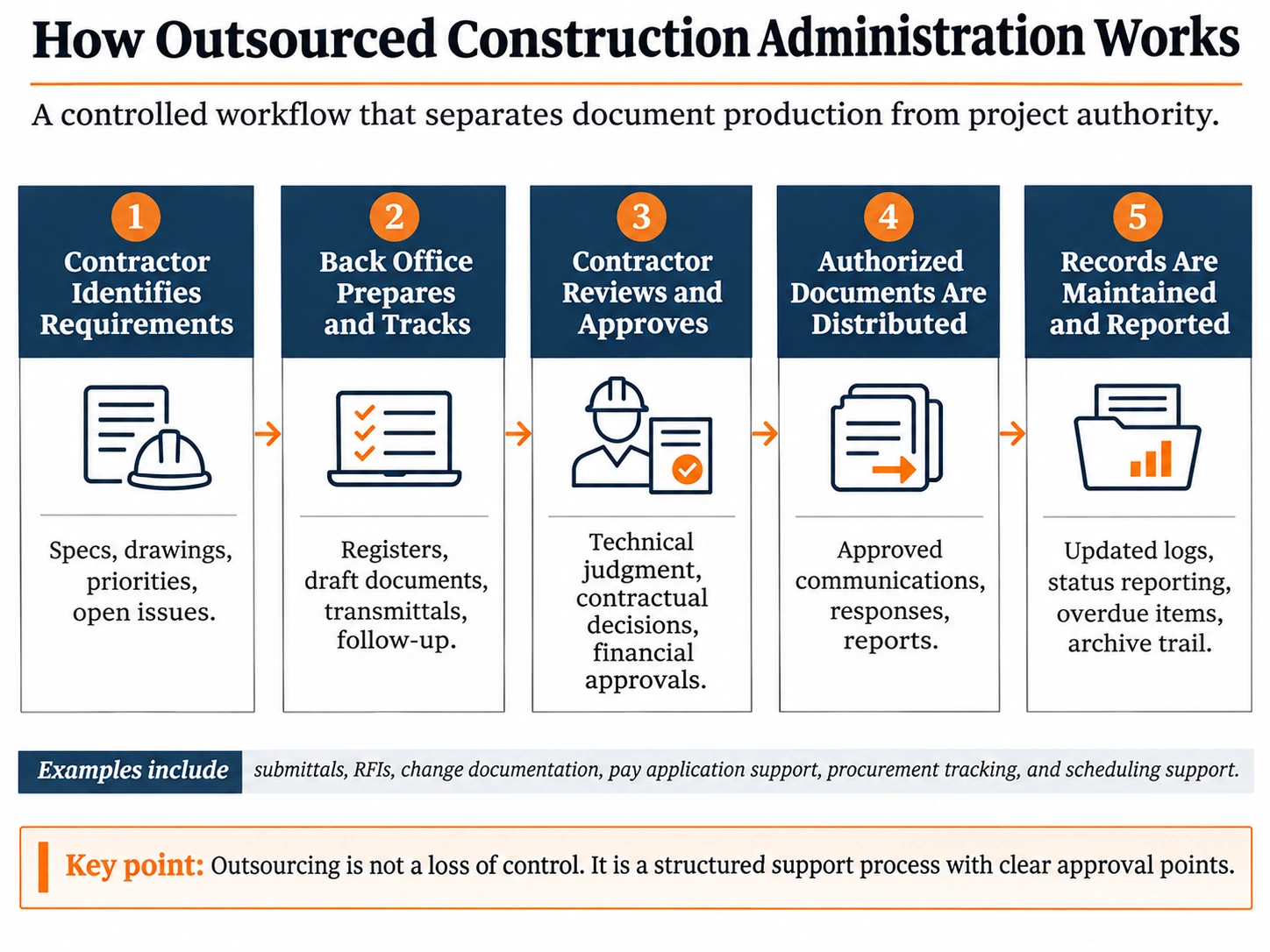
The most effective outsourcing arrangements begin by identifying which functions require direct project authority and which functions can be produced administratively under contractor supervision.
Construction administration is not a single activity. It is a collection of connected processes, each with different technical requirements, deadlines, approval procedures, and consequences.
Open full-size exhibit
Submittal Management
Submittal management is one of the clearest examples of work suited to structured administrative support.
Depending on the contract, submittals may include shop drawings, product data, material samples, certifications, calculations, test reports, warranties, operating manuals, and other required documentation. Their purpose is to demonstrate that proposed materials, equipment, and construction methods satisfy the applicable contract requirements and review procedures.
A properly managed process begins with identifying the required submittals from the specifications and drawings. These requirements are entered into a register, assigned to responsible parties, and connected to the dates when approvals will be needed to support procurement and construction.
As packages are prepared, they must be checked, processed, transmitted, tracked through review, and coordinated for resubmission when necessary.
A back-office provider can develop and maintain the register, coordinate administrative follow-up with vendors and subcontractors, assemble documentation, prepare transmittals, record review comments, and report outstanding approvals.
The contractor's designated technical and quality-control personnel remain responsible for the reviews, certifications, and approvals required by the contract. The outside provider should not represent that administrative processing alone establishes technical compliance.
For federal construction, this distinction is especially important. Unified Facilities Guide Specification 01 33 00 establishes submittal procedures and quality-control responsibilities that must be followed when incorporated into a particular contract.
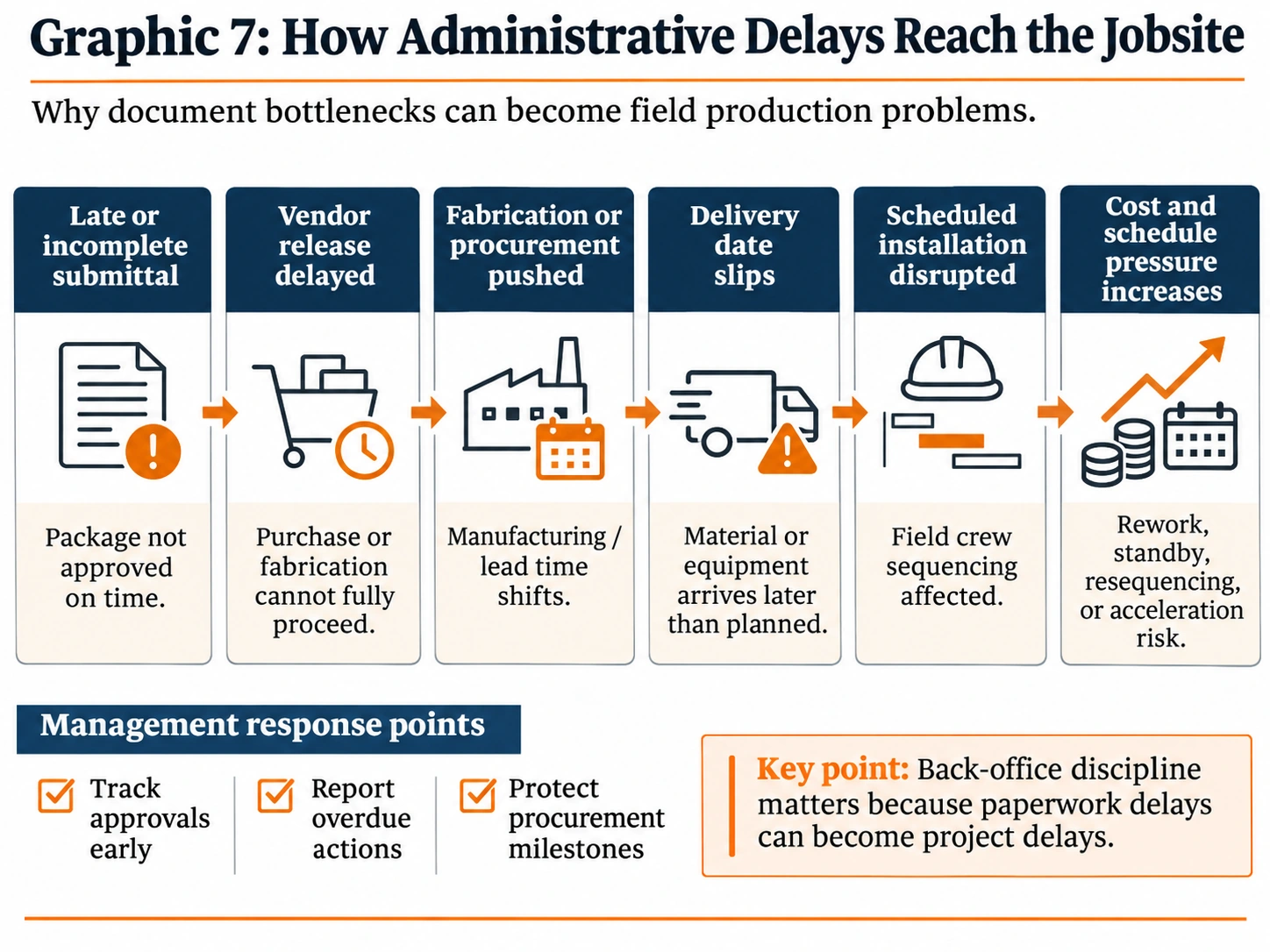
The operational value of outsourcing submittal administration is not merely that documents are processed. It is that project management receives an organized account of what has been submitted, what remains outstanding, what requires correction, and which approvals could affect procurement or construction activities.
Open full-size exhibit
Request for Information Administration
RFIs are essential when contract documents contain ambiguities, omissions, discrepancies, or conditions requiring formal clarification.
An RFI should identify a specific issue, reference the applicable documents, and clearly explain the clarification required. Poorly prepared RFIs can generate unnecessary correspondence, incomplete answers, or repeated requests for information.
A remote administrative provider can prepare draft RFI packages from contractor-supplied information, attach supporting drawings, maintain the RFI register, track response dates, and distribute authorized answers.
The contractor must still determine what question needs to be asked, whether the response resolves the technical issue, and whether the answer creates a potential change in scope, cost, or time.
This separation allows the project team to focus on the substance of the issue rather than the mechanics of preparing and tracking the paperwork.
Construction Document Control
Document control involves maintaining an accurate record of the information used to administer and construct the project.
Depending on the project, this includes contract drawings, specifications, addenda, bulletins, ASIs, approved submittals, correspondence, meeting records, change documentation, inspection records, and other official project information.
The challenge is not simply storing files. It is ensuring that records can be located, identified by revision, and associated with the appropriate project events.
A back-office operation can maintain document naming conventions, organize project folders, update revision registers, distribute approved documents, and preserve correspondence histories.
The contractor retains authority over which documents are accepted as controlling and how those documents affect the work. Field personnel must continue to verify that they are constructing from the correct authorized information.
An organized document control system reduces the effort required to reconstruct decisions and supports more reliable communication throughout the project.
Change Order Documentation
Change management is among the most commercially sensitive activities in construction administration.
A change may originate from an owner directive, design clarification, unforeseen condition, differing site condition, subcontractor issue, or other event. Establishing entitlement, pricing the work, evaluating schedule implications, and obtaining authorization may require substantial project management judgment.
The administrative side of this process is also considerable.
Change event records may include correspondence, drawings, field reports, labor information, material quotations, subcontractor proposals, cost estimates, schedule analysis, and negotiation history.
A back-office provider can maintain the change event register, organize supporting documentation, prepare draft change narratives, track proposal status, and assemble packages for management review.
The contractor retains responsibility for determining contractual entitlement, approving costs, negotiating changes, and authorizing commitments.
The provider's purpose is to make the necessary information complete, accessible, and available when decisions must be made.
Pay Application and Financial Administration Support
Progress payments depend on accurate records of completed work, contract values, approved changes, stored materials where permitted, retainage, and other contract-specific requirements.
Administrative support can assist with gathering subcontractor payment applications, organizing schedule-of-values information, checking document completeness, assembling backup, and preparing draft reports.
For applicable federal fixed-price construction contracts, FAR 52.232-5 establishes requirements for substantiating progress payment requests and contractor certification.
An outside provider can help prepare the supporting materials. The contractor must retain responsibility for verification, certification, authorized submission, and compliance with financial and contractual requirements.
This division is equally important in commercial and public-works construction.
Outsourcing pay application support does not mean transferring general accounting authority, banking control, payment approval, or fiduciary responsibility. Full bookkeeping, payroll processing, accounts payable, and financial reporting are separate functions that may require additional accounting qualifications, internal controls, and contractual arrangements.
The administrative opportunity lies in removing repetitive document preparation and coordination from project management without compromising the contractor's financial oversight.
Meeting Minutes and Action Registers
Construction meetings generate decisions, commitments, deadlines, and unresolved issues.
Without reliable records, participants may leave with different understandings of responsibilities or completion dates.
A back-office provider can prepare draft meeting minutes from authorized notes or recordings, maintain action item registers, identify outstanding commitments, and track follow-up requirements.
The project manager must verify the accuracy of decisions and commitments before official distribution. The provider should not independently create instructions or imply agreement where none exists.
The benefit is continuity. Outstanding issues remain visible from one reporting period to the next rather than becoming scattered across emails and personal notes.
Vendor and Subcontractor Administrative Coordination
A considerable amount of project administration involves collecting information from vendors and subcontractors.
This may include missing submittals, product data, delivery confirmations, insurance documentation, closeout records, quotations, and outstanding correspondence.
An administrative provider can track requested materials and coordinate their receipt through established communication procedures.
Purchasing decisions, contractual notices, commitments, technical direction, and subcontractor performance management remain with the contractor.
This boundary is particularly important when the provider does not have direct contractual authority to issue instructions to subcontractors.
Procurement and Long-Lead Tracking
Long-lead materials and equipment can affect project sequencing well before they arrive on site.
A procurement register should identify critical items, required approval dates, purchasing milestones, fabrication status, expected delivery dates, and potential impacts on construction activities.
A remote provider can maintain the register, obtain authorized status updates, identify overdue actions, and produce exception reports.
The project manager remains responsible for procurement strategy, commercial decisions, vendor commitments, and determining how delays affect the construction schedule.
The operational advantage is that potentially troublesome procurement items can be identified before the delivery date becomes an immediate field problem.
Project Reporting
Project managers need accurate information to understand current performance.
Administrative reports may summarize outstanding submittals, unanswered RFIs, open changes, procurement concerns, schedule milestones, document revisions, and upcoming management actions.
A support provider can compile these records into consistent reports and maintain the underlying registers.
The contractor must verify the accuracy of the information and determine which corrective actions are necessary.
A useful report should not merely list everything that has happened. It should distinguish routine activity from items requiring management attention.
Construction Scheduling and Project Controls
Scheduling is a specialized area of construction administration that requires careful technical oversight.
A CPM baseline schedule establishes relationships among construction activities, milestones, durations, and the sequence of work. Subsequent updates record actual progress and evaluate the remaining path to completion.
Primavera P6 and Microsoft Project can support these activities, although the required platform, schedule format, specifications, and contractual procedures vary by project.
A qualified remote scheduling provider can assist with baseline development, schedule calculations, updates, critical-path evaluation, procurement milestones, reporting, and cost or resource loading when included in the agreement.
The contractor remains responsible for supplying accurate field information, approving construction logic, identifying actual progress, evaluating recovery options, and satisfying contract requirements.
An outsourced scheduler cannot determine what physically happened in the field without reliable input.
For contractors with intermittent scheduling demands, purchasing specialized scheduling services can be more practical than maintaining full-time scheduling capacity. The financial value depends on the frequency of the work, required technical expertise, review obligations, and quality of deliverables.
Construction Closeout Documentation
Closeout administration begins long before the project reaches substantial completion.
Depending on contract requirements, closeout materials may include warranties, operation and maintenance manuals, record drawings, test reports, certifications, commissioning documents, attic stock records, training information, and other specified deliverables.
A provider can maintain the closeout register, request missing documents, organize submissions, and track review comments.
The contractor must verify that the required work has been performed, the documents accurately reflect project conditions, and the contract's closeout obligations have been satisfied.
When closeout records are maintained throughout construction, the final documentation effort becomes less dependent on reconstructing months of missing information.
The common feature across these functions is that administrative production can often be separated from the management decisions it supports.
4. In-House Staffing Versus Outsourced Support: The Financial Comparison
The financial case for outsourcing construction administration is frequently oversimplified.
Comparing a full-time employee's annual salary to a lower-priced outsourced service does not establish a valid cost saving unless the purchased service performs the same work at the required level of capacity and quality.
A construction manager, project engineer, administrative coordinator, and outside submittal management provider do not necessarily perform equivalent duties.
A useful comparison must therefore distinguish employee compensation, administrative workload, service scope, and the financial value of capacity recovered.
Understanding the Full Cost of Employment
double-count expenses
The Bureau of Labor Statistics reported the following May 2025 national median annual wages:
| Occupational category | Annual median wage |
|---|---|
| Construction managers | $114,990 |
| Project management specialists | $102,320 |
| Secretaries and administrative assistants | $48,310 |
These occupational groups provide useful benchmarks, but they should not be treated as identical to a particular contractor's project engineer or project administrator position. Actual salaries depend on experience, geographic market, employer size, project complexity, and job responsibilities.
The employee's wage is also not the employer's complete compensation expense.
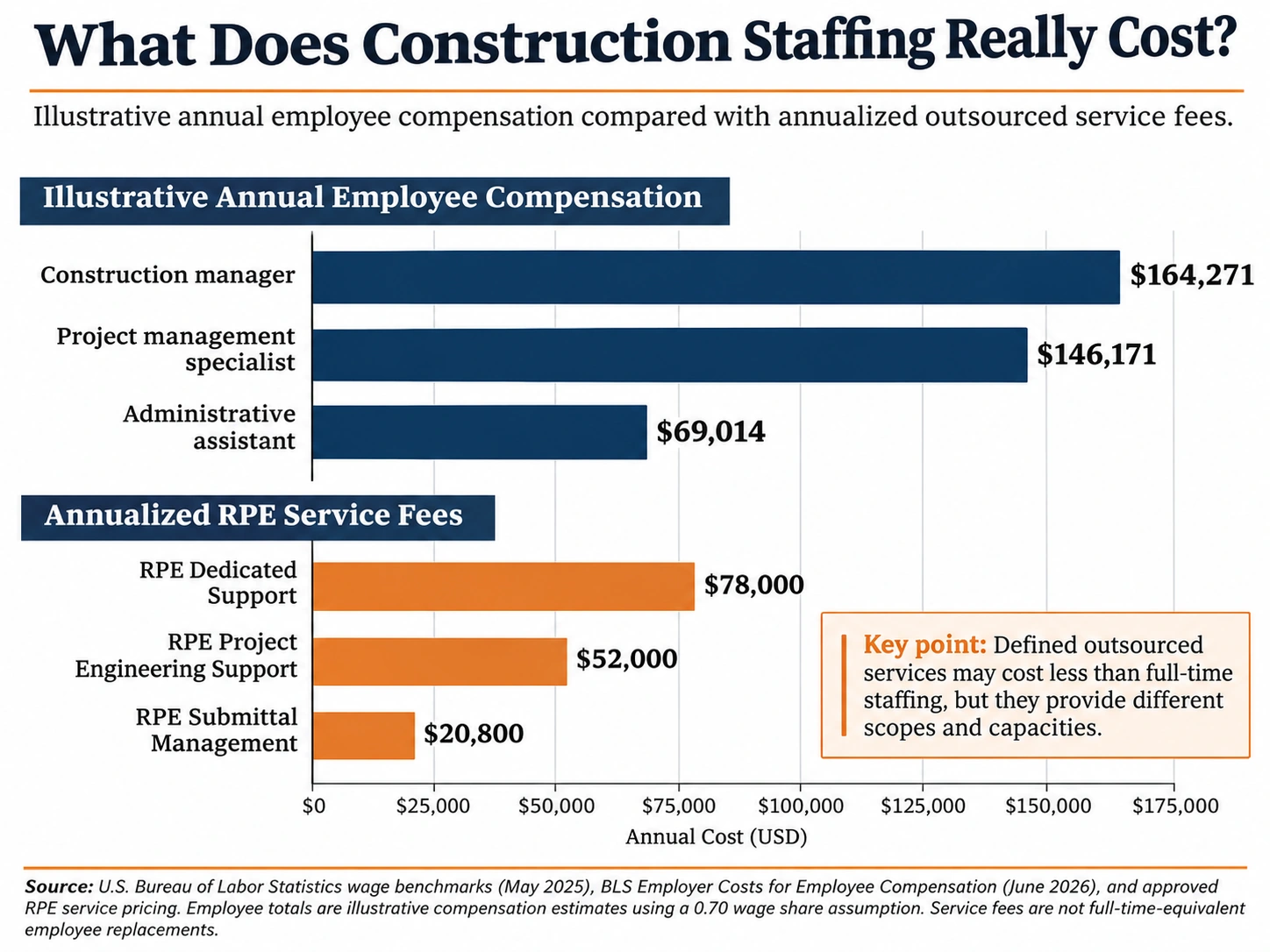
BLS reported that private-industry wages and salaries represented 70% of total employer compensation costs in June 2026. Applying that aggregate relationship to the wage benchmarks produces an illustrative compensation model.
| Occupational benchmark | Base annual wage | Illustrative total annual compensation |
|---|---|---|
| Construction manager | $114,990 | $164,271 |
| Project management specialist | $102,320 | $146,171 |
| Administrative assistant | $48,310 | $69,014 |
The calculation divides the annual wage by 0.70. This is a broad private-industry illustration, not an independently measured construction-specific burden for each position.
It also does not separately add recruiting fees, equipment, software, office costs, or onboarding expenses. Some employer costs are already represented within the compensation measure, adding generic overhead percentages without proper definitions could double-count expenses.
Open full-size exhibit
Comparing Defined Service Fees
Remote Project Engineer offers defined construction back-office support services with initial 12-week engagement periods.
Submittal Management starts at $400 per week, representing $4,800 over the initial 12 weeks. Project Engineering Support starts at $1,000 per week, representing $12,000 over the same period. Dedicated Project Engineer Support starts at $1,500 per week, representing $18,000 over 12 weeks.
For illustration, the corresponding service fees over 52 weeks would be $20,800, $52,000, and $78,000, respectively, assuming continuous service at those weekly rates.
These figures demonstrate the cost of the stated service packages, not the price of full-time employee replacements. Each arrangement has defined responsibilities and capacity limitations. The dedicated support service should not automatically be interpreted as providing a 40-hour-per-week employee.
The contractor must compare the work it actually needs against the work included in the agreement.
Example: A Contractor With a Concentrated Submittal Workload
Consider a contractor preparing to begin construction on a project with substantial equipment and material approvals.
The project manager and project engineer must coordinate vendors, confirm required submittals, maintain the register, prepare transmittals, track design reviews, and address resubmissions.
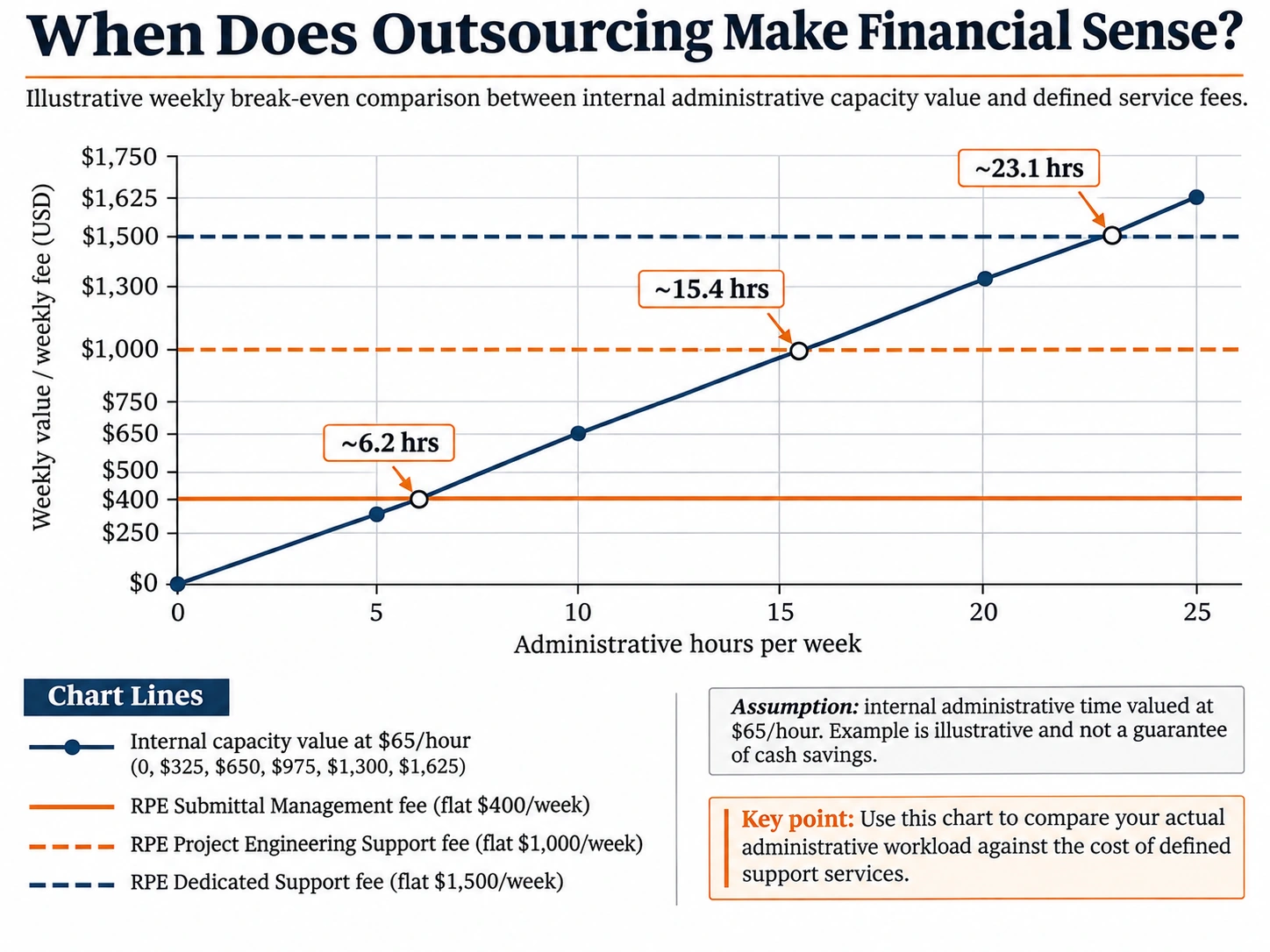
Suppose the contractor estimates that administrative processing will consume eight hours per week during the next 12 weeks.
If the internal compensation value of that time is assumed to be $65 per hour, the administrative workload represents $6,240 of employee capacity during the period.
A $4,800 submittal management engagement would cost $1,440 less than that illustrative capacity value, provided the work transferred is covered by the service and can actually be performed at the required volume and quality.
This does not automatically create $1,440 in cash savings.
If the contractor retains the existing employee and continues paying the same salary, the payroll expenditure remains unchanged. The financial benefit arises only if the released time is used productively, reduces overtime, avoids additional staffing, or contributes to another measurable economic outcome.
The same comparison may produce a different result if the contractor needs only two administrative hours per week or if the outsourced service requires extensive internal supervision.
The proper calculation is therefore not simply the employee's salary minus the provider's invoice.
It is the cost of the service compared with the avoidable cost or demonstrable value of performing that specific work internally.
Open full-size exhibit
Avoided Hiring Versus Recovered Management Capacity
Two financial scenarios deserve separate consideration.
The first occurs when outsourcing avoids the need to hire additional personnel. In that situation, the contractor may avoid some combination of wages, benefits, recruiting expense, training, equipment, and long-term staffing obligations. The actual benefit depends on whether the proposed employee would otherwise have been hired and whether the outsourced service covers the required responsibilities.
The second occurs when existing employees remain in place but transfer administrative production to an outside provider.
In that situation, the contractor purchases additional operating capacity. A project manager may be able to concentrate on cost management, procurement, coordination, or another active project. Those outcomes may have financial value, but the value should be measured instead of assumed.
A contractor that spends $12,000 on project engineering support over 12 weeks should evaluate the work completed, management time recovered, additional oversight required, and any avoided expense.
If the support system merely transfers work from one individual to another while creating equal amounts of coordination and correction, the arrangement may provide little economic benefit.
The strongest financial justification emerges when the provider performs a genuinely needed function, the contractor's internal administrative burden decreases, and the resulting benefit exceeds the service expense.
When the Numbers Do Not Favor Outsourcing
Outsourcing is not always the least expensive option.
A contractor with a fully staffed administrative department and unused employee capacity may gain little by paying an outside provider to complete work its existing personnel can already perform.
Likewise, a project requiring continuous technical coordination, daily field verification, or immediate decision-making may be better served by an internal project engineer familiar with the project and physically available to the team.
The question is not whether outsourcing is universally cheaper than employment. The question is whether the contractor can obtain the required administrative result at a more appropriate total cost without weakening project performance.
5. Operational Benefits, Disadvantages, and Risks
Cost is only one consideration in deciding whether construction administration should be outsourced.
A properly structured back-office operation can provide consistent document procedures, additional administrative capacity, and more predictable reporting. It may reduce the need for project managers to personally chase routine information or reconstruct the status of unresolved documents.
It can also create problems if the relationship is poorly organized.
Consistency and Continuity
Construction administration depends on reliable records.
Submittal registers, RFI logs, change event records, procurement trackers, and reporting systems are most useful when maintained continuously rather than updated only when an issue becomes urgent.
A dedicated administrative process can help maintain that continuity.
The value is particularly apparent when one project manager supervises multiple projects. Instead of each project developing different methods of tracking the same information, the company can establish consistent administrative procedures across its portfolio.
Those procedures must still accommodate each project's contract requirements, owner expectations, and software environment.
Flexible Capacity
Construction workloads fluctuate.
One project may generate a large volume of submittals during startup, while another requires intensive closeout administration. A third may need schedule updates and reporting support but relatively little document processing.
A managed-service arrangement allows a contractor to purchase selected support functions without automatically committing to a permanent position for every temporary increase in demand.
The actual flexibility depends on the provider's contract terms, available capacity, notice requirements, and ability to expand or reduce the agreed scope.
Communication and Quality-Control Risks
An outside provider does not automatically have the same project knowledge as an employee working alongside the superintendent and project manager.
Poor communication can result in incomplete documents, incorrect assumptions, outdated information, or delays in resolving administrative issues.
A successful relationship needs designated points of contact, documented procedures, clear approval authority, agreed reporting intervals, and a reliable method for escalating urgent matters.
Quality control is equally important.
The contractor should understand how the provider checks documents before presentation, how corrections are handled, and what happens when information is missing or inconsistent.
Administrative support should make the contractor's management process easier, not create another layer of uncertainty.
Confidentiality, Cybersecurity, and Software Access
Construction documents can contain commercially sensitive information, including pricing, contract terms, proprietary drawings, personnel information, and project-specific security requirements.
External access must therefore be managed carefully.
Contractors should provide only the permissions necessary for the agreed work, use individually assigned accounts where supported, control the distribution of sensitive documents, and establish procedures for removing access when the engagement ends.
Projects involving federal facilities, military installations, controlled information, or contract-specific cybersecurity obligations may require additional restrictions.
Software capability must also be evaluated realistically.
A provider familiar with Procore, Autodesk Construction Cloud, Bluebeam, Microsoft Project, or Primavera P6 still needs access to the contractor's particular project environment, approved procedures, and current records.
Software familiarity does not substitute for construction knowledge or contract compliance.
Contractual Responsibility Remains With the Contractor
Outsourcing administrative work does not relieve a contractor of its contractual obligations.
The contractor remains responsible for required technical reviews, safety, quality control, schedule performance, project direction, payment certifications, and authorized commitments.
A provider can prepare and track information supporting those obligations. It should not be represented as independently assuming responsibilities that belong to the contractor under the construction contract.
This distinction protects the relationship from unrealistic expectations.
6. When Outsourcing Makes Operational Sense
Outsourcing is most appropriate when the contractor has a definable administrative need that can be performed without continuous physical presence or independent management authority.
One common situation occurs when a contractor wins additional work but does not yet have enough predictable backlog to justify expanding permanent administrative staff.
The company may have qualified project managers and superintendents capable of overseeing the new projects, but the combined document requirements exceed the available administrative capacity.
Purchasing support for submittals, RFIs, or reporting can help distribute that workload while allowing management to remain focused on execution.
Another situation occurs when a project develops a submittal backlog.
The immediate issue may not be the technical complexity of the documents. It may be that vendors have not supplied required information, incomplete packages have been returned, or the submittal register no longer provides a reliable picture of outstanding approvals.
A structured administrative effort can identify missing items, organize required documents, and restore a workable tracking process.
The contractor must still ensure that technical reviews and procurement decisions occur in time to protect the project schedule.
Federal and public-works construction provides another application.
Projects with detailed specifications, formal approval procedures, extensive reporting, and substantial closeout obligations may require administrative effort beyond what a small contractor normally maintains internally.
An outside provider familiar with the applicable procedures can assist with document production and tracking, provided the contractor retains the required quality-control, certification, and contractual responsibilities.
Scheduling provides a different example.
A contractor may need a Primavera P6 baseline schedule at the beginning of a project, monthly updates during execution, and specialized analysis when the critical path changes. If that workload does not justify a full-time scheduler, project-based scheduling support may be a more appropriate staffing arrangement.
Outsourcing may also make sense during temporary employee absences, periods of concentrated procurement activity, or closeout phases when document collection becomes intensive.
In each situation, the contractor should identify the actual workload before selecting a service.
The opportunity is strongest when the work can be defined, measured, and supervised without transferring essential project authority.
7. How to Evaluate a Construction Outsourcing Provider
The quality of an outsourced construction administration arrangement depends heavily on selecting the appropriate provider and establishing a clear operating agreement.
A contractor should begin by evaluating the provider's understanding of actual construction procedures.
Maintaining a submittal register requires familiarity with specifications, approval requirements, and the relationship between submittal status and procurement. Processing RFIs requires an understanding of contract documents, drawing references, correspondence, and the difference between clarification and authorization. Construction scheduling requires knowledge of activity logic, relationships, calendars, progress measurement, and schedule reporting.
A provider may be administratively efficient without possessing all the technical capabilities required for a particular project.
The contractor should determine which functions the provider can competently perform and which remain outside its scope.
Defining the Purchased Service
The service agreement should clearly identify included functions, deliverables, processing expectations, reporting requirements, software responsibilities, and limitations.
It should specify whether the price applies to one project or several, whether additional projects carry separate fees, and how work outside the agreed scope is handled.
A fixed weekly fee should not be interpreted as unlimited processing capacity unless the agreement expressly provides for it.
The contractor should also understand the initial commitment, termination requirements, document handover procedures, and responsibilities for maintaining records after the relationship ends.
Establishing Accountability
Every outsourced function needs an internal owner.
For example, the project manager may be responsible for RFI content and approval, while the provider maintains the register and manages administrative processing.
The superintendent may supply actual progress information, while a remote scheduler prepares the schedule update for contractor review.
The accounting department may verify payment values, while an administrative provider assembles the supporting application package.
These responsibilities should be established before production begins.
A provider that cannot clearly explain how work is received, checked, presented for approval, and completed may create more management effort than it removes.
Measuring Performance
The contractor should evaluate performance using meaningful operational measures.
For submittals, these may include register completeness, processing status, outstanding reviews, document corrections, and responsiveness within the provider's control.
For RFIs, the contractor may examine whether records are complete, responses are tracked, overdue items are identified, and authorized answers are distributed correctly.
For scheduling, measures may include update timeliness, quality of progress information, calculation integrity, and compliance with the required submission procedures.
The goal is not to count activity for its own sake.
The goal is to determine whether the back-office operation provides accurate, useful information and reduces the administrative demands placed on the contractor's management personnel.
8. How to Implement Outsourced Construction Management Support
A successful administrative outsourcing arrangement begins with preparation.
The contractor cannot reasonably expect an outside provider to establish effective project controls without receiving the governing documents, current project information, existing registers, and an understanding of the work already completed.
The first step is to define which administrative functions are being transferred.
A contractor purchasing submittal management support should identify the applicable project, specifications, drawings, existing submittal records, vendor contacts, required approval procedures, and immediate priorities.
A broader project engineering support engagement may require additional RFI logs, change event records, meeting information, project correspondence, procurement registers, and document control procedures.
Scheduling assignments require a different set of inputs, including contract milestones, sequencing requirements, existing schedule files, calendars, procurement information, and verified construction progress.
Once the required information is available, the provider and contractor should establish the initial administrative baseline.
This involves identifying current work, incomplete records, outstanding decisions, approaching deadlines, and matters requiring management attention.
The First Twelve Weeks
Open full-size exhibit
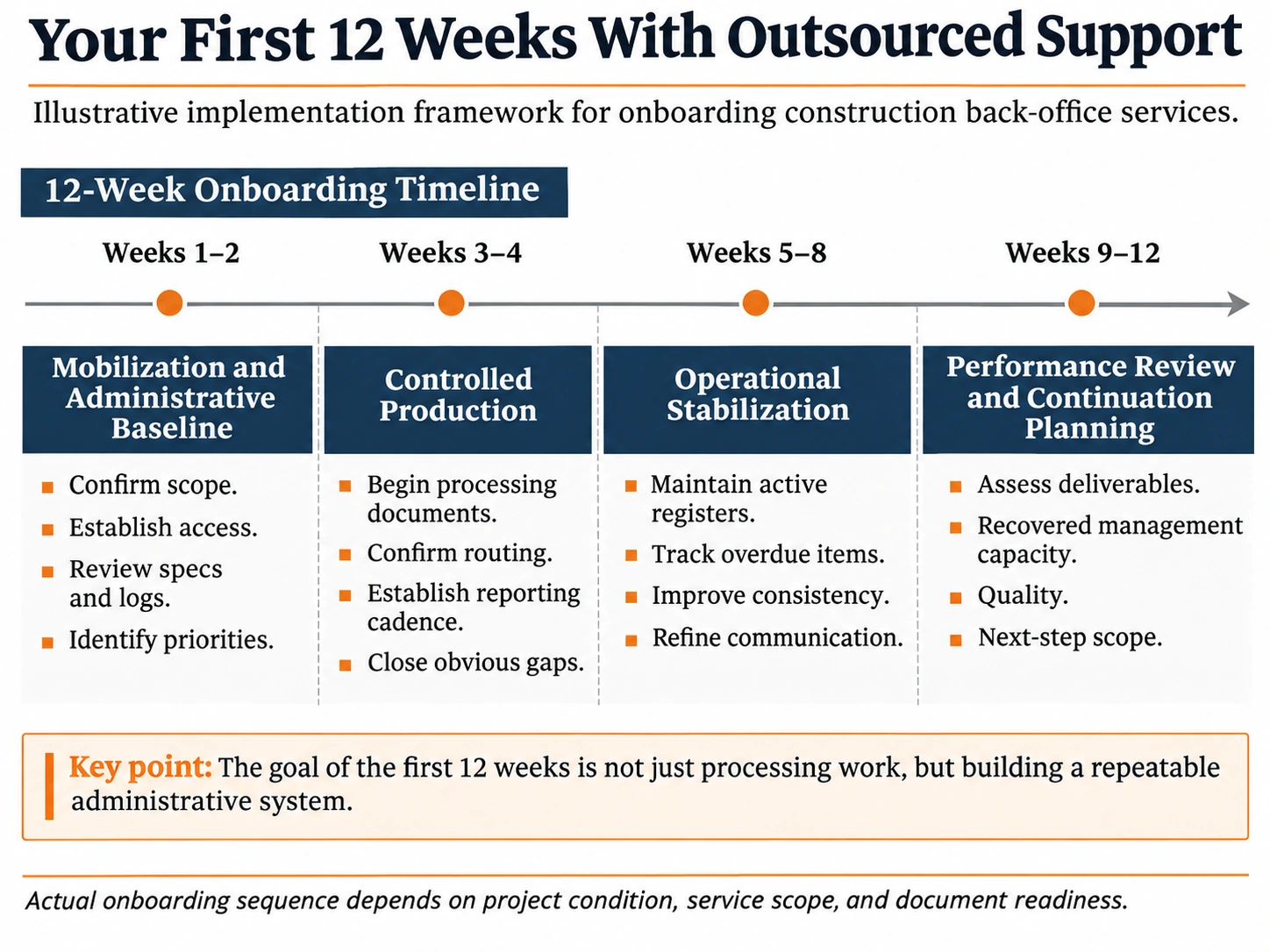
For a 12-week engagement, the initial period should concentrate on organizing the work and establishing an operating procedure.
During the first two weeks, the priority is generally to confirm scope, establish access, review project information, and identify outstanding administrative requirements. The exact sequence depends on project conditions and the service purchased.
The following weeks should establish routine production and reporting. Registers are maintained, documents are processed through approved procedures, outstanding issues are identified, and corrections are incorporated into the workflow.
As the operation stabilizes, the emphasis should shift toward consistency, accurate reporting, and reducing unnecessary management involvement in routine administrative work.
By the final portion of the initial engagement, the contractor should have sufficient information to evaluate the service.
That evaluation should examine whether the required work was performed, whether documentation improved, whether the project team received useful reports, and whether the amount of management attention required to supervise the provider was reasonable.
The contractor should also compare actual service costs against the administrative capacity recovered or employment expense avoided.
A successful engagement does not necessarily mean every document has been completed or every project issue resolved. Some matters depend on design approvals, vendor responses, field information, or decisions outside the provider's authority.
Success means that the agreed administrative responsibilities are being performed competently, the contractor retains visibility and control, and the arrangement provides measurable operational value.
Conclusion: Put Construction Management Resources Back Where They Belong
Construction management has always required documentation, coordination, and accountability. Those responsibilities have not become less important as project delivery has grown more complex.
The question facing contractors is how those responsibilities should be organized.
Project managers and superintendents are valuable because they understand construction execution, coordinate resources, solve problems, and make decisions that affect cost, schedule, quality, and performance.
When too much of their available time is consumed by repetitive administrative production, contractors risk misallocating some of their most important management resources.
Outsourcing selected back-office responsibilities provides an alternative.
Submittal processing, RFI tracking, document control, change order documentation, payment application preparation, procurement reporting, scheduling support, and closeout administration can often be organized into defined workflows performed under contractor supervision.
The financial benefit depends on the work being transferred, the cost of providing it internally, the price and capacity of the outsourced service, and how effectively the contractor uses the time or staffing resources recovered.
Outsourcing does not automatically reduce payroll, eliminate management responsibility, or guarantee better project performance.
It can, however, provide a practical way to separate administrative production from project decision-making and align specialized support with actual workload.
For contractors managing multiple projects, experiencing uneven administrative demand, or attempting to control fixed staffing expenses, that distinction deserves serious consideration.
The objective is not to manage construction remotely in place of the people responsible for building it.
The objective is to establish a reliable back-office operation that allows construction professionals to devote more attention to managing and delivering the work.
Source References
U.S. Bureau of Labor Statistics. Construction Managers: Occupational Outlook Handbook. May 2025 wage data. https://www.bls.gov/ooh/management/construction-managers.htm
U.S. Bureau of Labor Statistics. Project Management Specialists: Occupational Outlook Handbook. May 2025 wage data. https://www.bls.gov/ooh/business-and-financial/project-management-specialists.htm
U.S. Bureau of Labor Statistics. Secretaries and Administrative Assistants: Occupational Outlook Handbook. May 2025 wage data. https://www.bls.gov/ooh/office-and-administrative-support/secretaries-and-administrative-assistants.htm
U.S. Bureau of Labor Statistics. Employer Costs for Employee Compensation — June 2026. Released September 9, 2026. https://www.bls.gov/news.release/ecec.nr0.htm
Associated General Contractors of America. Construction Workforce Shortages Remain Acute Despite Soft Market Conditions. September 3, 2026. https://www.agc.org/news/2026/09/03/construction-workforce-shortages-remain-acute-despite-soft-market-conditions-data-centers-strain
Associated Builders and Contractors. Construction Industry Must Attract 349,000 Workers in 2026 Despite Macroeconomic Headwinds. January 15, 2026. https://www.abc.org/News-Media/News-Releases/abc-construction-industry-must-attract-349000-workers-in-2026-despite-macroeconomic-headwinds
U.S. Department of Defense. Unified Facilities Guide Specification 01 33 00 — Submittal Procedures. https://www.wbdg.org/FFC/DOD/UFGS/UFGS%2001%2033%2000.pdf
Federal Acquisition Regulation. FAR 52.232-5 — Payments Under Fixed-Price Construction Contracts. https://www.acquisition.gov/far/52.232-5
Financial illustration notes: RPE service pricing is based on the supplied business standards. Annual compensation figures are calculated by dividing the cited national occupational median annual wage by 0.70, using the BLS June 2026 aggregate private-industry compensation distribution as an illustrative assumption. These figures are not measured company-specific employment costs, and outsourced service fees do not imply full-time-equivalent labor capacity.