
Construction work plans are the difference between a crew that shows up ready to build and a crew that shows up ready to wait. A construction work plan defines how the work will actually get done — the scope broken into tasks, the information the field needs, the materials that must be on site, the safety steps, the inspections, the durations, and who is responsible for each piece — before the first worker mobilizes.
Most contractors already have a schedule. Many have a safety program, a submittal log, and an RFI log. What most do not have is one document that ties all of that together at the level the field actually works. That gap is where costly mistakes are born.
This article lays out seven proven reasons every project needs construction work plans, what happens when they are missing, and how a simple planning standard changes field execution from reactionary to controlled.
What Construction Work Plans Actually Are
A construction work plan is a pre-execution plan for a defined scope of work. It answers one question in detail: what has to be true before this work starts, and how will it be executed once it does?
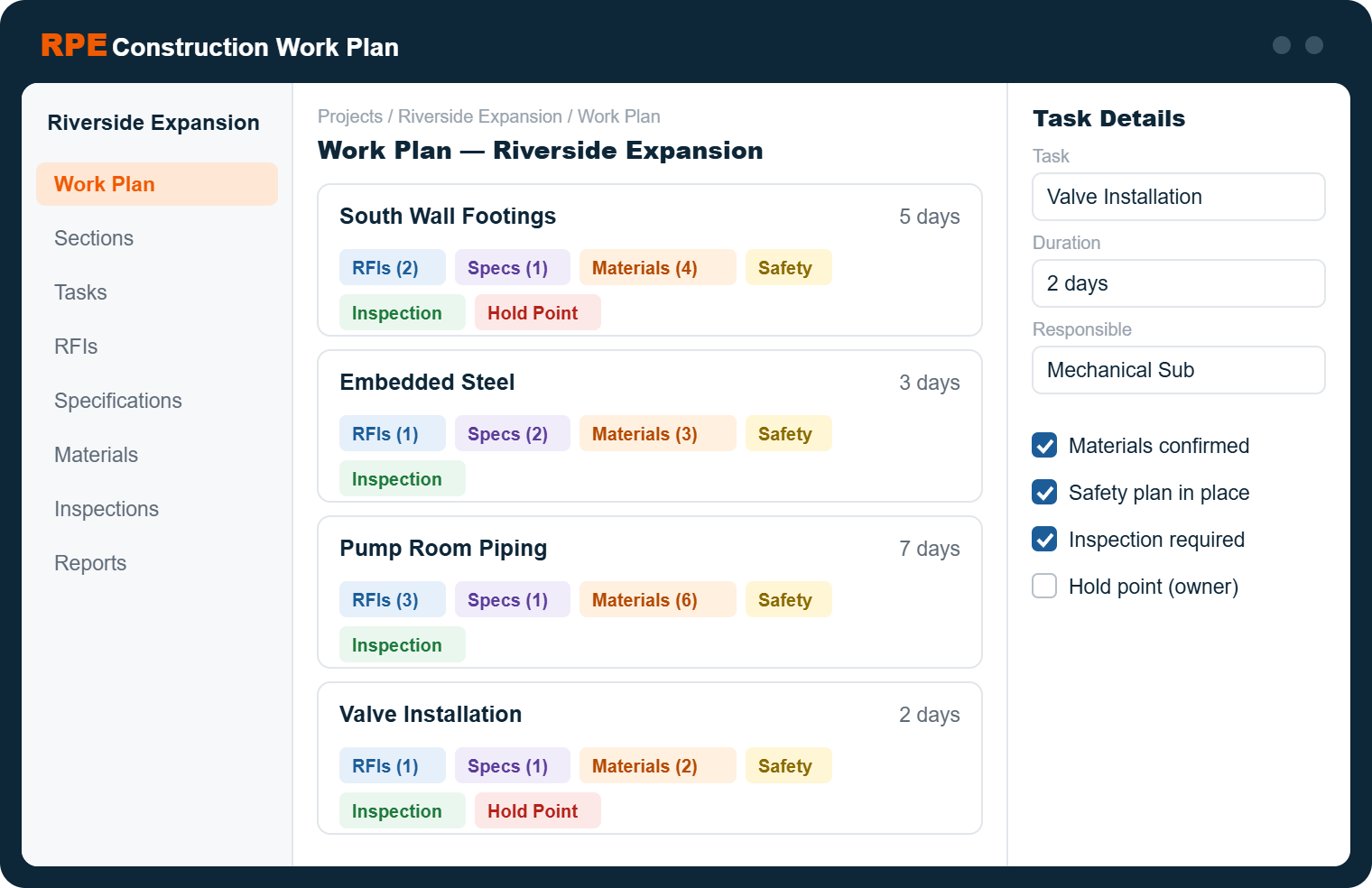
A practical construction work plan is organized by section — an area, a system, or a sequence that matches how the job is built. Each section is broken into tasks. Each task carries the information the crew needs to execute it without stopping.
- Scope and tasks — what is being built, broken into field-ready activities.
- RFIs and specifications — the questions answered and the spec sections that govern the work.
- Materials — what must be ordered, approved, delivered, and staged.
- Safety — the hazards and the controls required before the task starts.
- Inspections and hold points — what must be inspected, by whom, and when.
- Durations — how long each task should take, in hours or days.
- Responsibility — who owns each task and each prerequisite.
That is the entire concept. It is not complicated. It is simply rarely done with discipline.

Why Construction Work Plans Are Missing on So Many Projects
Construction rewards people who solve problems fast. Over time, that culture turns into a habit of solving problems in the field instead of preventing them in the office. The superintendent becomes the hero who finds the missing material, the PM becomes the person who chases the late answer, and the schedule absorbs the damage.
Planning gets skipped for three predictable reasons:
- No time. The PM is buried in paperwork and the superintendent is managing the current fire.
- No standard. Every person plans differently, so nothing is consistent and nothing is reviewable.
- No owner. Planning falls between the PM, the superintendent, and the project engineer, so nobody fully owns it.
Construction work plans fix all three. They give planning a format, a time in the process, and an owner.
7 Proven Reasons Every Project Needs Construction Work Plans
1. Construction Work Plans Stop Costly Material Surprises
The most common field delay is not a lack of labor. It is a crew standing next to work they cannot start because something is missing — an embed, a fitting, an approved product, a delivery that was never confirmed.
A construction work plan forces material readiness to be checked before mobilization. Every task lists the materials it needs, and every material is confirmed: approved, ordered, delivered, and staged. When the material column is not green, the task does not start. That single rule eliminates a large share of the waiting that drains productivity.
2. Construction Work Plans Put the Right Information in Front of the Crew
Field questions cost time twice: once when the crew stops to ask, and again when someone in the office hunts for the answer. Most of those answers already exist. They are sitting in an answered RFI, a spec section, or a revised drawing that never made it to the foreman.
Construction work plans link the relevant RFIs and specifications directly to the section and the task. The crew works from the right information instead of searching for it.
3. Construction Work Plans Make Responsibility Unmistakable
“I thought you had it” is one of the most expensive sentences on a jobsite. When responsibilities are verbal, they disappear the moment the conversation ends.
A construction work plan assigns an owner to every task and every prerequisite — the material order, the inspection request, the RFI follow-up, the equipment. Accountability is written down, visible, and reviewable in the weekly meeting.
4. Construction Work Plans Build Safety Into the Work, Not Around It
Safety planning often happens in a separate document that the crew never connects to the actual task. A construction work plan puts the hazards and the required controls on the same line as the work itself.
When the plan says a task requires fall protection, a lift, a permit, or an excavation inspection, those items become prerequisites — not afterthoughts. For federal requirements and general guidance, the OSHA construction industry resources are a practical reference when building the safety section of a plan.
5. Construction Work Plans Protect Inspections and Hold Points
A missed inspection does not just delay the next activity. It can force work to be uncovered, re-inspected, or redone. Hold points owned by the owner or a third party are especially unforgiving.
Construction work plans identify every inspection and hold point in advance, assign who requests it, and set when it must happen. The inspection becomes part of the sequence instead of a surprise at the end of it.
6. Construction Work Plans Turn the Schedule Into Executable Work
A CPM schedule tells the team when work should happen. It rarely tells the crew how it will happen. That gap is why a schedule can look healthy on paper while the field struggles.
A construction work plan takes the schedule activity and breaks it into the tasks, information, materials, and durations needed to hit it. The schedule sets the target. The work plan is how the field hits the target.
7. Construction Work Plans Create a Repeatable Standard
The best superintendents already plan this way in their heads. The problem is that what lives in one person’s head cannot be reviewed, shared, or repeated.
Construction work plans turn good planning habits into a company standard. Every project is planned the same way, every PM and superintendent reviews the same format, and every new hire learns one method. That consistency is what separates contractors who grow from contractors who simply get busier.
What Happens Without Construction Work Plans
Every contractor has lived this week. The schedule says the work starts Monday. On Monday, the crew arrives and discovers the inspection was never requested, the approved product is not the one on site, and the answer to the open RFI is sitting in someone’s inbox.
The cost is not one bad day. It is the chain reaction: idle labor, a re-mobilization, overtime to recover, a strained relationship with the general contractor, and a superintendent who spends the next month reacting instead of leading.
Industry research consistently points to waste as the core problem. Autodesk notes that construction sees nearly double the waste of manufacturing, with more than half of work spent on non-productive activities. Planning is the most direct lever a contractor controls to reduce that waste. Organizations such as the Lean Construction Institute have built entire methods around the same principle: plan the work, then work the plan.
Who Should Own Construction Work Plans?
Construction work plans succeed when each role does its part:
- The project manager sets the standard, reviews the plan, and protects the time to plan.
- The superintendent drives the sequence, the crew logic, and the field reality.
- The project engineer supports the plan with RFIs, submittals, materials status, and documentation.
When one of those roles is missing or overloaded, planning is the first thing that disappears. That is exactly where outside support helps. Remote Project Engineer provides project engineering support and dedicated project engineers who support the planning effort behind your PM and superintendent.
How to Start Using Construction Work Plans This Week
You do not need a new department to start. You need a simple, repeatable format and the discipline to use it before work begins.
- Pick one upcoming scope of work starting in the next two to three weeks.
- Break it into sections that match how the work will actually be built.
- List the tasks in each section in the order they will be performed.
- Attach the information — RFIs, spec sections, and current drawings — to each task.
- Confirm materials for every task: approved, ordered, delivered, staged.
- Add safety and inspections as prerequisites, with an owner for each.
- Set durations and responsibilities, then review the plan with the PM and superintendent before mobilizing.
Run that process on one scope. Then run it on the next one. Within a few weeks, the difference in field execution is obvious.
A Construction Work Plan Built by a Project Manager
Remote Project Engineer’s Construction Work Plan was built from a general contractor’s perspective by a construction project manager with more than 25 years in the industry — including an award-winning construction work plan. It is a web-based planning tool that brings sections, tasks, RFIs, specifications, materials, safety, inspections, durations, and responsibilities into one clear pre-execution plan.
The goal is simple: make planning the normal way work starts, not the exception.
The Bottom Line on Construction Work Plans
The cowboy days of building first and figuring it out later are over. Owners expect predictability, general contractors expect coordination, and margins do not survive rework.
Construction work plans are the simplest proven tool for getting ahead of the work. They stop costly material surprises, put the right information in front of the crew, assign responsibility, build in safety and inspections, and turn the schedule into something the field can execute.
Plan the work first. React less later. Learn how the Construction Work Plan brings it all together.