
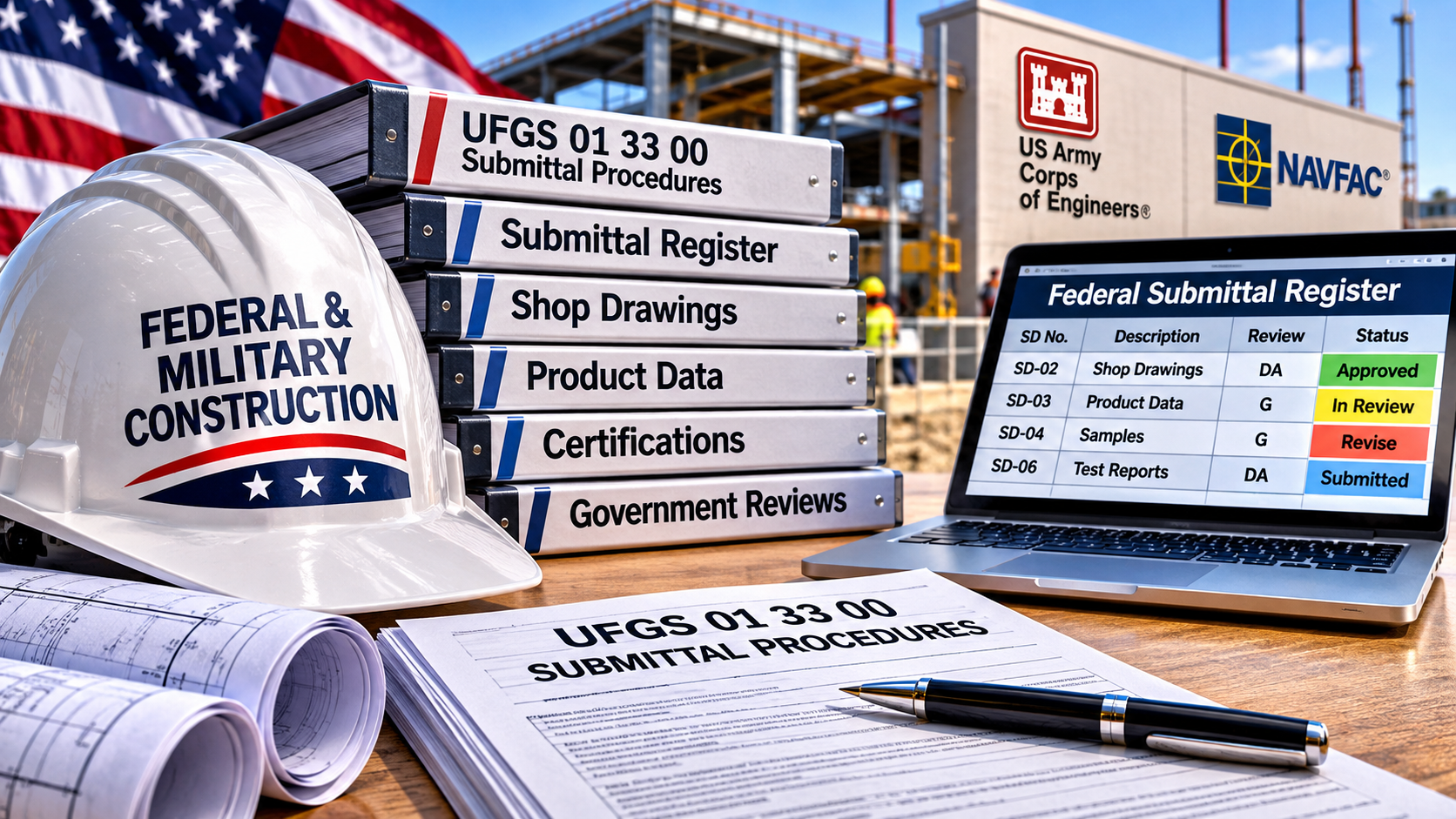
Understanding UFGS requirements, government review classifications, submittal registers, and the administrative responsibilities behind federal construction.
Construction submittals services play an important role in federal and military construction projects, where documentation requirements extend well beyond preparing shop drawings and uploading product information.
For contractors working on U.S. Army Corps of Engineers (USACE), Naval Facilities Engineering Systems Command (NAVFAC), and other federal construction projects, managing submittals is a contract administration responsibility requiring careful attention to specifications, approval authorities, contractor quality control, and project records.
A commercial contractor entering federal construction may already understand the basic submittal process. Shop drawings are prepared, product information is assembled, and documents move through the required reviews.
However, federal construction introduces additional controls.
The contract may establish specific submittal classifications, government approval requirements, controlled transmittals, electronic documentation systems, certification procedures, and detailed registers.
Failure to understand these requirements can create administrative problems before construction activities reach the field.
The purpose of effective construction submittals services is to organize and maintain the required documentation process while preserving the contractor’s technical and contractual responsibilities.
1. Why Federal Construction Submittals Require Greater Administrative Control
Federal construction projects operate under contracts that frequently incorporate detailed technical specifications and administrative procedures.
These requirements help establish which materials, equipment, methods, and documents must be submitted for review before particular construction activities proceed.
The contractor is responsible for identifying those requirements, coordinating subcontractor and supplier information, completing required internal reviews, and forwarding documentation through the proper channels.
The administrative complexity increases when the project includes multiple specification divisions, specialty subcontractors, long-lead equipment, government approval authorities, and strict contract milestones.
A submittal package may require manufacturer information, engineering calculations, shop drawings, testing documentation, certifications, installation instructions, or other supporting materials.
Different documents may follow different review classifications.
An item designated for government approval must not be processed as though it requires only contractor quality-control review.
A missing certification, incorrect specification reference, or improperly documented variation can result in additional review cycles.
For the project manager, the challenge is maintaining accurate information about every required submission while continuing to manage construction operations.
This is the administrative burden that specialized construction submittals services can help control.
2. Understanding UFGS Section 01 33 00 — Submittal Procedures
One of the principal references used in federal construction is the Unified Facilities Guide Specifications (UFGS).
UFGS Section 01 33 00, Submittal Procedures, establishes a structured framework for identifying, preparing, submitting, reviewing, and maintaining construction submittals.
The August 2026 edition addresses submittal information, quality control, review classifications, submission requirements, package preparation, and submittal management.
The specification distinguishes among several approval and review classifications, including Government Approved (G), Designer of Record Approved (DA), certain government conformance reviews, and For Information Only classifications.
These classifications matter because they determine who must perform the applicable review and how the documentation moves through the process.
The UFGS also organizes submittals using standardized Submittal Description categories, commonly identified as SD numbers.
Examples include:
| Classification | Description | Typical documentation |
|---|---|---|
| SD-01 | Preconstruction Submittals | Plans, schedules and required preconstruction information |
| SD-02 | Shop Drawings | Fabrication and installation details |
| SD-03 | Product Data | Manufacturer technical information |
| SD-04 | Samples | Material samples and physical examples |
| SD-05 | Design Data | Calculations and design information |
| SD-06 | Test Reports | Required testing documentation |
| SD-07 | Certificates | Certifications and attestations |
| SD-08 | Manufacturer’s Instructions | Product installation and related instructions |
| SD-09 | Manufacturer’s Field Reports | Manufacturer field observations and reports |
| SD-10 | Operation and Maintenance Data | Equipment operation and maintenance records |
| SD-11 | Closeout Submittals | Contract-required closeout documentation |
These categories provide an organized means of identifying different documentation requirements.
They do not establish that every project requires every category. The applicable contract specifications determine what must actually be submitted.
The controlling document is the project’s contract specification, including its modifications and amendments—not the unmodified UFGS master section alone.
Technical reference:
Unified Facilities Guide Specifications — Section 01 33 00
3. Government Approved Does Not Mean Every Submittal Goes to the Government
One of the more important distinctions in federal submittal administration is identifying the required approval authority.
Not every construction document necessarily requires the same review.
Depending on the applicable contract and delivery method, some submittals require government approval. Others may be reviewed and accepted through the contractor’s quality-control process, the Designer of Record, or another designated authority.
The classification must be determined from the contract.
Consider a project requiring product data for several common building materials and a specialized mechanical system.
The applicable specification may establish different submittal classifications based on the importance of the material, the system’s technical requirements, or the designated review responsibility.
An administrative coordinator who assumes every package follows the same approval route may create unnecessary delays or fail to recognize required government involvement.
Effective submittal administration begins by identifying the applicable classification and routing each package accordingly.
An outside provider can support this process by maintaining accurate classification records, preparing properly identified packages, and tracking the responsible reviewing authority.
However, administrative personnel do not acquire government approval authority simply because they manage the submittal register or transmit the package.
4. The Federal Construction Submittal Register
The submittal register is one of the most important management tools on a federal construction project.
It identifies required submissions, responsible parties, specification references, review classifications, anticipated dates, actual submission records, and current status.
A federal project may require the register to be maintained in a prescribed format or approved electronic construction management system.
Depending on the contract, the applicable administrative environment may include the USACE Resident Management System Contractor Mode (RMS CM), a successor or designated construction management platform, or another required system.
Contractors should not assume that the software used on one government project will satisfy the requirements of another.
The contract and current agency instructions govern.
What the register must help the contractor understand
An effective federal submittal register should make it possible to identify:
- Every required submittal and its specification reference.
- The applicable SD classification.
- The designated reviewing or approving authority.
- The subcontractor or supplier responsible for preparation.
- Required submission and procurement milestones.
- The date a package was received and forwarded.
- Current review status and outstanding actions.
- Revisions, resubmissions, and final disposition.
- Documentation required for the project record.
The register should be maintained as the project progresses.
A register that was accurate at mobilization may become unreliable if later specification changes, additional submittal requirements, revised packages, or actual review dates are not recorded.
Federal submittal management is a continuing administrative process—not a one-time spreadsheet assignment.
5. Contractor Quality Control and Administrative Responsibility
Federal construction projects frequently establish formal contractor quality-control obligations.
Those responsibilities must remain with the personnel and organizations designated by the contract.
The contractor may be required to review submissions for conformity with contractual requirements, verify coordination among the applicable trades, and provide certifications or other documentation before forwarding a package.
An outsourced administrator can help assemble the submission and confirm that required administrative elements are present.
For example, the administrator may identify a missing product data sheet, absent test report, incorrect specification reference, or incomplete transmittal.
Those are administrative completeness issues.
Determining whether the proposed equipment meets the specified performance criteria or whether an engineered design is technically acceptable requires the appropriate qualified review and authorization.
This distinction protects the contractor and the integrity of the project documentation.
Construction submittals services should support the quality-control process, not substitute for it.
6. Example: A Federal Mechanical Equipment Submittal
Consider a hypothetical federal construction project requiring a large air-handling unit.
The technical specification identifies product data, shop drawings, and other documentation associated with the equipment.
The contractor’s submittal register identifies the required packages and their applicable classifications.
The mechanical subcontractor obtains the manufacturer’s equipment information and prepares the required submission.
Before the package is forwarded, the contractor must complete the review required under the contract.
The administrator can support the process by checking whether all required documents are included, confirming the proper specification references, tracking the package’s revision number, and maintaining the submission record.
The package then moves through the appropriate review channel.
If the submission is returned for correction, the administrator records the disposition, identifies the responsible party, and tracks the resubmission.
Meanwhile, the project manager must determine whether the outstanding approval affects purchasing, fabrication, equipment delivery, or the planned installation sequence.
This is where submittal administration and project scheduling connect.
A properly maintained register provides information needed to evaluate procurement concerns. It does not independently resolve the technical issues or guarantee approval.
Illustrative workflow
| Stage | Administrative responsibility | Contractor responsibility |
|---|---|---|
| Requirement identified | Enter required package into register | Confirm applicable contract requirements |
| Package requested | Track supplier documentation | Direct subcontractor performance |
| Package received | Check administrative completeness | Perform required technical/QC review |
| Formal submission | Prepare approved transmittal and record | Authorize submission |
| Review tracking | Monitor status and report outstanding items | Address technical and contractual issues |
| Resubmission | Maintain revisions and correspondence | Approve required corrections |
| Final record | Archive current documentation | Ensure contract compliance |
This example illustrates division of responsibilities; the actual contract controls.
7. The Connection Between Submittals and Federal Construction Scheduling
A construction schedule can contain hundreds or thousands of activities, but its reliability depends on identifying the approvals and procurement activities that affect construction.
Long-lead equipment, critical fabrication packages, specialty systems, and materials requiring formal approval may influence the timing of subsequent work.
If the approval process is not coordinated with procurement and the construction schedule, the contractor may discover that an installation activity is approaching before the necessary documentation and purchasing decisions are complete.
Submittal information can support scheduling through:
- Identifying procurement-critical approvals.
- Establishing submission and review milestones.
- Tracking outstanding resubmissions.
- Reporting items potentially affecting material release.
- Communicating status to the project manager and scheduler.
On contracts requiring Primavera P6 or other specified CPM scheduling systems, these milestones may need to be incorporated into the project’s approved schedule structure.
The specific schedule requirements depend on the contract.
Remote Project Engineer offers construction scheduling support as a separate service using Microsoft Project and Primavera P6.
The submittal management and scheduling functions complement each other, but they are not automatically included in one commercial package.
8. Why Federal Contractors Consider Outsourcing Submittal Administration
A federal construction project manager already carries substantial responsibilities.
The PM may be coordinating subcontractors, reviewing change proposals, monitoring procurement, managing correspondence, tracking cost exposure, and communicating with the government project team.
Submittal administration adds a continuous flow of registers, packages, review records, revisions, and follow-up responsibilities.
The issue is not whether these tasks are necessary.
They are.
The question is whether all administrative production must be performed personally by the project manager.
A specialized administrative provider may help by establishing controlled registers, organizing vendor submissions, maintaining review histories, tracking outstanding actions, and reporting potential procurement concerns.
That support may reduce routine administrative workload and improve record visibility.
However, its value depends on the actual project requirements, authorized system access, defined deliverables, workload capacity, and the level of contractor review still required.
Outsourcing should not be presented as transferring contract compliance, construction management authority, or government-facing technical responsibility to an outside provider.
The contractor must remain responsible for its contractual obligations.
9. What Construction Submittals Services Cost
Remote Project Engineer provides a defined Submittal Management service for U.S. contractors.
The standard service begins at $400 per week, with a 12-week initial engagement of $4,800 for one project within the agreed scope.
It is designed to support administrative submittal responsibilities, including:
- Register development and maintenance.
- Authorized vendor and supplier follow-up.
- Administrative package pre-screening.
- Document organization and transmittal support.
- Review-status tracking.
- Revision and resubmission control.
- Outstanding approval reporting.
- Procurement-risk visibility.
Federal and military projects may have additional contract-specific requirements, including prescribed document management systems, specialized approval workflows, security conditions, certifications, or unusual package volumes.
Those requirements must be evaluated before confirming the engagement scope and price.
The standard service is not a guarantee of unlimited document processing or government approval.
For commercial terms and defined service responsibilities, visit:
Construction Submittals Services — Remote Project Engineer
10. Evaluating the Business Case for Outsourced Federal Submittal Administration
The financial question is broader than the price of administrative labor.
Federal contractors must consider the cost of existing project management resources, required documentation quality, project-specific systems, internal review time, and the administrative effort needed to keep submittals current.
Hiring an additional employee may be appropriate for a contractor with a continuing portfolio of large federal projects.
For a contractor facing temporary increases in administrative workload, a defined outsourced support arrangement may be worth evaluating.
The comparison should address the actual scope of work being transferred rather than assuming an outsourced service is equivalent to a full-time project engineer.
Potential benefits include recovered project management capacity, more consistent tracking, clearer reporting, and reduced need for additional permanent administrative staffing.
Those benefits are not guaranteed cash savings.
Remote Project Engineer has published a broader research paper examining outsourcing economics, staffing considerations, risks, and responsibilities.
Read: Outsourcing Construction Management — Costs, Benefits, Risks & Best Practices
The research provides additional context for contractors considering how to organize construction administration without surrendering project authority.
11. Questions Federal Contractors Should Ask Before Engaging a Provider
Before outsourcing administrative responsibilities, federal contractors should establish whether the provider can work within the requirements of the particular contract.
Questions include:
Can the provider organize submittals according to the contract’s UFGS classifications?
The administrator must understand which classifications and submission procedures apply to the project.
Who performs the contractor’s required quality-control review?
The service agreement must preserve the designated contractor review and certification responsibilities.
Which construction management system is required?
The contractor should confirm software, access, cybersecurity, documentation retention, and authorized communication procedures.
How are revisions and resubmissions maintained?
The provider should describe how current versions, previous review comments, and the official submission history will be controlled.
How are overdue packages and reviews escalated?
The service should identify reporting procedures and the contractor personnel responsible for management action.
Does the service include technical design review?
Administrative completeness checking and technical engineering approval are different responsibilities. Any specialized technical review must be separately defined and performed by appropriately authorized personnel.
These questions help ensure that outside support strengthens the project administration process without creating confusion about responsibility.
Conclusion: Better Submittal Administration Without Losing Project Control
Federal and military construction submittals require disciplined administration.
Specifications establish the required documentation. Review classifications determine the applicable approval process. Contractor quality-control procedures establish review responsibilities. Submittal registers track the records needed to maintain project visibility.
When these activities are properly coordinated, the project manager has better information about outstanding reviews, unresolved packages, procurement concerns, and required follow-up.
Construction submittals services can provide valuable administrative support, but they do not replace the contractor’s responsibility for compliance, technical review, or project delivery.
For federal construction contractors evaluating additional administrative capacity, the objective should be to establish a controlled, clearly defined support process behind the existing project management team.
Remote Project Engineer provides construction back-office support designed around that principle.
Your team manages construction. RPE manages the administrative work behind it.
Learn More About Construction Submittals Services
Discover the scope, pricing, and service responsibilities:
https://remoteprojectengineer.com/construction-submittals-services/
Additional Educational Research
Outsourcing Construction Management: Costs, Benefits, Risks & Best Practices
https://remoteprojectengineer.com/outsourcing-construction-management/
Technical References
Whole Building Design Guide — Unified Facilities Guide Specifications
UFGS Section 01 33 00, Submittal Procedures, August 2026.
https://www.wbdg.org/FFC/DOD/UFGS/UFGS%2001%2033%2000.pdf
Whole Building Design Guide — UFGS Library
Current federal construction specification resources and revisions.
Remote Project Engineer — Construction Submittals Services
https://remoteprojectengineer.com/construction-submittals-services/
Remote Project Engineer — Outsourcing Construction Management Research
https://remoteprojectengineer.com/outsourcing-construction-management/