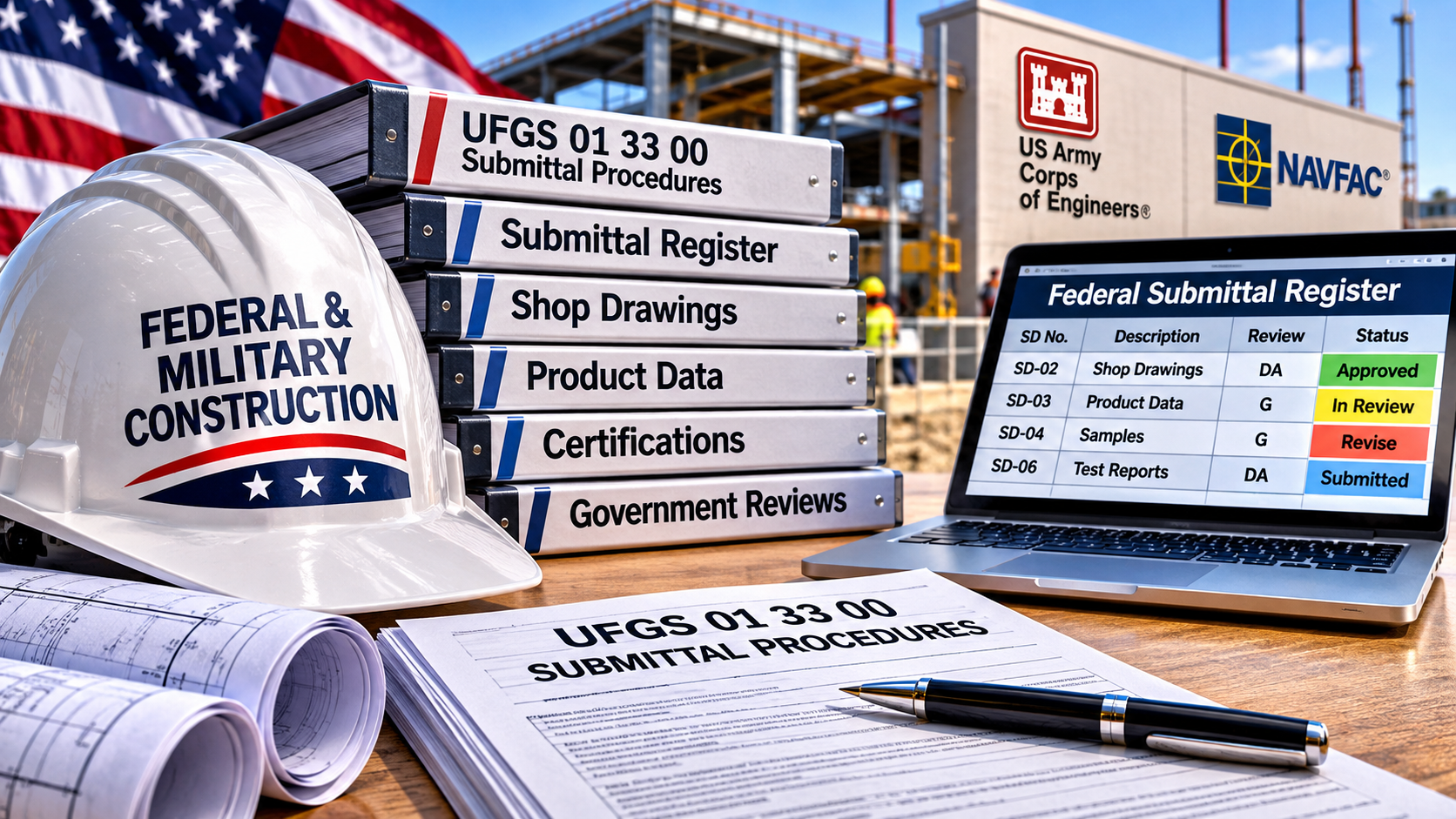

An educational guide for general contractors, subcontractors, and construction project managers.
Introduction: The Submittal Process Is Part of Construction Management
A construction project can have an excellent superintendent, an experienced project manager, and a well-developed schedule—and still experience delays because one equipment submittal never made it through the approval process.
It happens more easily than contractors care to admit.
The mechanical subcontractor is waiting on a manufacturer. The project engineer is missing a product data sheet. The architect has returned a package for revision. The procurement team believes the equipment was approved three weeks ago.
Meanwhile, the project schedule continues moving toward an installation date that may no longer be achievable.
This is why construction submittals services are not simply about uploading PDFs or forwarding emails.
Effective submittal administration is a controlled process that connects contract specifications, subcontractor responsibilities, design-team reviews, procurement activities, and the construction schedule.
When that process is poorly managed, project managers spend valuable time chasing missing information instead of making decisions about the project.
When it is properly managed, the contractor gains visibility into what has been submitted, what has been reviewed, what remains outstanding, and which approvals require management attention.
Understanding that process begins with the contract documents.
1. Construction Submittals Begin With the Specifications
Before a contractor can manage submittals, the project team must establish what the contract actually requires.
The starting point is the project specification book, particularly Division 01 and the technical specification sections governing individual materials, products, systems, and equipment.
Those sections identify required documentation, review procedures, submission formats, and responsibilities.
Depending on the project, required construction submittals may include shop drawings, product data, samples, certificates, testing information, manufacturer instructions, quality-control documentation, warranties, and operation and maintenance materials.
A submittal register organizes these requirements into a working management document.
The register should identify each required submission, the applicable specification section, the responsible subcontractor or supplier, the anticipated submission date, and the review status.
On projects with substantial procurement requirements, the register should also account for material lead times, required approval dates, and related construction milestones.
A register developed without reviewing the specifications is little more than an incomplete checklist.
The purpose of the register is not simply to record paperwork. It is to identify the information that must be reviewed before the work can proceed.
What a practical submittal register contains
A useful working register typically includes:
- Submittal number and specification reference.
- Description of the required material or document.
- Responsible subcontractor or supplier.
- Required or planned submission date.
- Date received and date formally submitted.
- Current reviewer or ball-in-court responsibility.
- Review status and return date.
- Revision or resubmittal requirements.
- Procurement or schedule impact.
- Final disposition and document reference.
The precise fields depend on the contract and project management platform.
The important point is consistency. A project manager should be able to open the register and identify outstanding items without reconstructing the history from emails.
2. The Construction Submittal Workflow: Seven Control Points
An effective submittal process follows a defined sequence. Individual contracts may establish additional review requirements, but the underlying administrative controls remain similar.
Control Point 1 — Identify the Requirement
The project team reviews specifications, drawings, and addenda to identify required submittals.
Each requirement is entered into the register, assigned to a responsible party, and connected to the planned work sequence.
Missing a required submittal at this stage can create problems later, particularly when the item involves long-lead equipment or fabrication.
Control Point 2 — Request the Documentation
The responsible subcontractor or supplier must assemble the applicable documentation.
The administrator tracks outstanding requests, follows up on promised dates, and records commitments.
A vendor’s statement that a package is being prepared is not the same as receiving a complete package.
Control Point 3 — Perform an Administrative Completeness Check
Before formal submission, the package should be checked against the applicable administrative requirements.
This includes confirming the correct specification reference, revision identification, required attachments, product information, and applicable transmittal details.
An administrative check does not replace technical examination by the responsible contractor or design professional.
It helps prevent missing paperwork from entering the formal review process unnecessarily.
Control Point 4 — Complete Contractor Review and Submission
The contractor performs the technical and contractual review required by the project documents before forwarding the package.
Once properly reviewed and authorized, the submission moves through the established document management system.
A controlled transmittal establishes what was submitted, by whom, when, and for which specification requirement.
Control Point 5 — Track the Review
The administrator tracks the package through the responsible review authority.
The record should identify whether the item is submitted, under review, returned, awaiting correction, or otherwise disposed of under the project’s approved review-status system.
Overdue responses should be reported through the appropriate communication and escalation channels.
Control Point 6 — Manage Revisions and Resubmittals
A returned package may require additional supporting information, corrected drawings, product clarification, or replacement documentation.
Each revision must be identifiable and traceable to the previous submission.
The administrator monitors the resubmittal, records comments, and confirms that the updated package is routed through the proper review workflow.
Control Point 7 — Maintain the Accepted Record
After the required review process is complete, the current authorized documentation must remain available to the appropriate project participants.
Superseded material should not be confused with the current record.
The approved or otherwise accepted submittal history also supports procurement coordination, project documentation, and eventual closeout.
The system only works when every step has an assigned responsibility and a visible status.
3. Why Submittal Delays Become Procurement Problems
Consider a commercial building requiring an air-handling unit with a substantial manufacturing lead time.
For illustration, assume the contractor needs the equipment delivered in Week 24.
The supplier requires ten weeks for fabrication and delivery after receiving the necessary release. The contractor therefore needs to establish an appropriate procurement release date, taking into account the project’s actual fabrication conditions.
Now assume the submittal is returned for revision and remains unresolved for three weeks.
If the procurement sequence has no available float, the delay may affect the planned delivery date and subsequent installation work.
The problem is not necessarily the review itself. It may be the absence of timely information about the item’s current status and the decisions required to keep procurement moving.
A properly managed submittal system makes that condition visible.
The project manager can see the review status, identify who owes the next action, coordinate with the supplier, and evaluate the effect on procurement and the construction schedule.
Illustrative procurement control example
| Activity | Planned timing | Management requirement |
|---|---|---|
| Identify equipment requirements | Week 1 | Confirm applicable specifications |
| Receive vendor package | Week 3 | Track completeness and outstanding items |
| Contractor review and submission | Week 4 | Confirm proper authorization |
| Review and revisions | Weeks 5–7 | Track comments and resubmittals |
| Procurement release | Week 8 | Confirm contractual and purchasing authorization |
| Fabrication and delivery | Weeks 9–18 | Monitor supplier commitments |
| Installation milestone | Week 24 | Coordinate with construction schedule |
Illustrative sequence only; not a recommended contractual review duration or actual project schedule.
The value of submittal management is visibility and control—not a guarantee that every review will finish on time.
This relationship between document administration and construction scheduling is one reason submittal registers should be reviewed alongside procurement logs and CPM schedules.
4. Federal and Military Construction Submittals Require Additional Attention
Federal and military construction contracts frequently contain detailed procedures for preparing, classifying, transmitting, reviewing, and maintaining construction submittals.
One important technical reference is Unified Facilities Guide Specification (UFGS) Section 01 33 00 — Submittal Procedures.
The August 2026 edition addresses matters including submittal descriptions, approval classifications, submission requirements, package preparation, and administrative control.
The specification distinguishes among review classifications such as Government Approved, certain Designer of Record and design-build review classifications, and For Information Only, subject to the requirements of the contract.
A submittal labeled for government approval is not administratively interchangeable with an item submitted for information.
The responsible review authority, the required contractor review, and the appropriate submission process must be established from the applicable contract documents.
Federal construction submittal administration may require additional attention to:
- UFGS submittal description classifications.
- Government and contractor review responsibilities.
- Contractor quality-control documentation.
- Proper transmittal and certification requirements.
- Approved project document management systems.
- Submission and resubmission histories.
- Procurement and contract milestone coordination.
The controlling requirements are always the actual contract specifications and applicable amendments, not assumptions based on a prior project.
For technical reference, see UFGS Section 01 33 00 — Submittal Procedures.
Administrative assistance can help organize these workflows, but it does not transfer the contractor’s quality-control obligations or the government’s designated approval responsibilities to an outside service provider.
5. What Happens When the Project Manager Personally Manages Every Submittal?
On many construction projects, the submittal register becomes another responsibility assigned to an already busy project manager.
Initially, the workload may appear manageable.
A few packages arrive. The PM reviews them, forwards them, responds to vendors, and updates the log.
As procurement increases, the process becomes more demanding.
Multiple suppliers request clarification. Review comments arrive at different times. Revisions must be processed. A/E responses need follow-up. Long-lead equipment requires particular attention.
None of these tasks can simply be ignored.
But not all of them require the project manager’s personal involvement.
There is a meaningful difference between deciding whether a proposed product meets project requirements and tracking whether the vendor submitted the required manufacturer information.
The first requires appropriate technical judgment and authority.
The second can often be managed through a controlled administrative process.
This is where specialized construction submittals services may provide operational value.
The contractor retains the project decisions, technical responsibilities, and contractual authority while assigning defined documentation and tracking tasks to a supporting team.
Evaluating the workload
Before considering outsourced support, contractors should ask:
- How much project management time is currently spent on submittal administration?
- How many packages are outstanding or awaiting resubmission?
- Does the project team have a reliable, current register?
- Are procurement-critical submittals visible in the project schedule?
- Is there a clear process for contractor review and authorization?
- Would shifting administrative work allow the PM to focus on higher-priority construction responsibilities?
The answer should be based on actual project conditions, not on an assumption that outsourcing always costs less.
6. What Professional Construction Submittals Services Should Include
A contractor evaluating outside submittal support should expect clearly defined responsibilities and deliverables.
At a minimum, the proposed service should explain whether it includes register development, vendor follow-up, administrative package review, formal submission support, review tracking, revision management, and periodic reporting.
It should also define the contractor’s responsibilities.
Contractor responsibilities
The contractor ordinarily remains responsible for directing the project, verifying technical requirements, coordinating field construction, authorizing submissions, and fulfilling the contract.
Design professionals and other designated reviewing authorities retain their applicable review responsibilities.
Submittal administration responsibilities
An outside provider may perform defined administrative tasks such as maintaining registers, collecting supplier documentation, checking package completeness, preparing transmittals, tracking reviewer status, coordinating authorized follow-up, and producing status reports.
A credible service agreement must distinguish administrative production from technical approval authority.
Another important consideration is workload capacity.
A $400-per-week administrative service is not automatically equivalent to employing a full-time project engineer.
Contractors should understand what is included, how work is prioritized, how exceptional backlogs are handled, and which services require separate authorization.
7. How Remote Project Engineer Approaches Submittal Management
Remote Project Engineer (RPE) provides construction back-office support for U.S. general contractors and specialty subcontractors.
Its Construction Submittals Services offering is designed to manage the administrative workload behind the submittal process while the contractor retains project authority.
The service includes defined functions such as:
- Developing and maintaining the project submittal register.
- Coordinating authorized vendor and supplier follow-up.
- Performing administrative pre-screening of incoming packages.
- Organizing submittal documentation and transmittals.
- Tracking review status and ball-in-court responsibilities.
- Maintaining revision and resubmittal records.
- Identifying outstanding approvals and procurement concerns.
- Providing status reporting to the project manager.
RPE’s standard Submittal Management service starts at $400 per week, with an initial 12-week commitment of $4,800, for one project within the agreed service scope.
This is managed construction administration, not an unlimited hourly labor arrangement.
Contractor review, technical approval responsibilities, and contract performance remain with the appropriate project participants.
For a detailed explanation of the commercial service, deliverables, and engagement process, visit:
Construction Submittals Services — Remote Project Engineer
8. Is Outsourcing Submittal Management Financially Justified?
The cost comparison should begin with the actual workload.
A contractor employing a project manager is already paying for that employee’s time. Outsourcing administrative support does not necessarily eliminate the employee’s salary or reduce payroll expense.
Instead, the potential financial value may come from recovering management capacity, reducing the need for additional administrative hiring, improving continuity, or controlling temporary workload increases.
For example, if an outsourced service allows a project manager to redirect several hours per week from register maintenance and vendor follow-up toward procurement decisions, cost control, field coordination, or subcontractor management, the contractor may gain operational capacity.
Whether that capacity produces measurable savings depends on project workload, staffing arrangements, and the contractor’s actual operating costs.
The comparison should account for both the purchased service and any internal review or coordination that remains necessary.
A construction outsourcing decision becomes more defensible when the contractor measures:
- Administrative workload before and after implementation.
- Outstanding and overdue submittal counts.
- PM time spent on routine administrative activities.
- Accuracy and completeness of project registers.
- Timeliness of reporting and escalation.
- The actual service cost against the value of recovered capacity.
RPE has published a separate research paper examining these issues in more detail:
Outsourcing Construction Management: Costs, Benefits, Risks & Best Practices
The research discusses staffing economics, outsourcing responsibilities, risks, and practical implementation considerations for U.S. contractors.
9. Questions to Ask Before Hiring a Submittal Service Provider
A contractor should not select a provider solely because it advertises low pricing or promises to process paperwork quickly.
Ask how the service operates.
Who builds the initial register? Who checks the specification requirements? Who performs contractor technical review? What happens when a vendor submits incomplete documentation?
How are overdue reviews escalated? Who controls official correspondence? Which project system will be used? What happens when package volume increases substantially?
The provider should be able to describe its workflow clearly and identify the responsibilities it does not assume.
For federal construction, contractors should also establish whether the proposed administrative workflow can accommodate contract-specific UFGS requirements and the approved project documentation environment.
These questions help determine whether the service will reduce the PM’s workload or simply create another administrative relationship that the PM must manage.
Conclusion: Submittal Management Is About Controlling the Process
Construction submittals are a necessary part of project delivery. The challenge is maintaining a reliable process as the volume of documents, reviewers, suppliers, and procurement commitments increases.
Good submittal management begins with the specifications, establishes an accurate register, assigns responsibilities, controls package revisions, tracks reviews, and gives the project manager timely information about outstanding decisions.
Those functions can often be organized as a defined construction back-office service without transferring the contractor’s responsibility for the project.
The business case is straightforward: project managers should spend their time managing construction decisions, not personally maintaining every administrative record supporting those decisions.
For contractors evaluating whether outside support makes sense, the next step is to compare the required administrative workload with the capabilities and costs of a clearly defined service.
Learn more about RPE Construction Submittals Services:
https://remoteprojectengineer.com/construction-submittals-services/
Additional research:
https://remoteprojectengineer.com/outsourcing-construction-management/
Technical References
Whole Building Design Guide — Unified Facilities Guide Specifications
UFGS Section 01 33 00, Submittal Procedures, August 2026.
https://www.wbdg.org/FFC/DOD/UFGS/UFGS%2001%2033%2000.pdf
Procore — Ultimate Guide to Submittals in Construction
Industry reference concerning submittal workflows, communication, review tracking, and document distribution.
https://www.procore.com/library/construction-submittals
Remote Project Engineer — Construction Submittals Services
Commercial service scope, responsibilities, and engagement pricing.
https://remoteprojectengineer.com/construction-submittals-services/
Remote Project Engineer — Outsourcing Construction Management
Educational research covering construction staffing, outsourcing economics, responsibilities, and implementation.
https://remoteprojectengineer.com/outsourcing-construction-management/